
Haldiram Franchise in India Cost, Requirements, Profit Margin In 2025
Are you thinking about entering one of the fastest-growing food and beverage markets in India with a trusted brand? Perhaps the license for Haldiram would bring your dreams to reality. Haldiram is famous for snacks, sweets, and restaurant formats, and the company has been known over the years for its quality and authenticity. So, if you want to invest, the following is a thorough and detailed account of the cost, application procedure, requirements, and profitability of the Haldiram outlet.
Why Partner with Haldiram?

Strong Brand Presence – Since Haldiram is an age-old, trusted name, franchise owners get an instant customer base.
Wide Product Offering – From packaged snacks and namkeens to sweets and ready-to-eat meals and "restaurant-style" food, the assortment has broad appeal.
Established Business Model – The company has had operational experience for several decades and streamlined its processes to enable franchisees to run outlets with ease.
Setup and Training Support – Generally, the franchise setup and training would include setup, supply-chain, and marketing support.
Growing Market – With increased spending by Indians for branded food experiences, the explosive escalation of growth is evident.
Types of Franchise Models

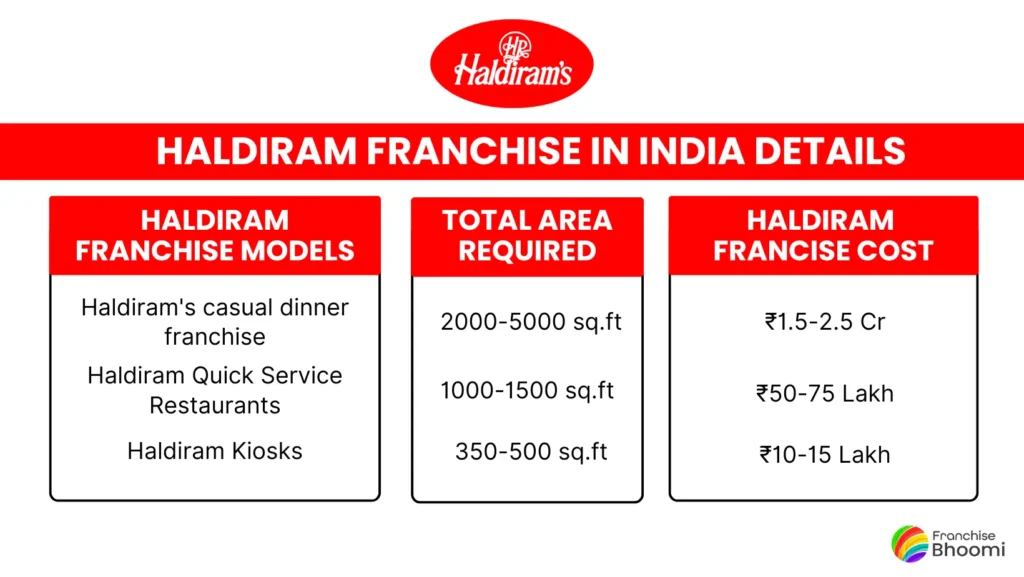
Haldiram offers different formats to suit varying budgets and locations:
Kiosk/Express Outlet – Small, takeaway-focused counters (100–350 sq. ft.) in high-footfall areas. Investment: ₹15–50 lakhs.
Quick Service Restaurant (QSR) – Medium-sized outlets (800–1,500 sq. ft.) with limited seating, serving snacks, chaat, and light meals. Investment: ₹40 lakhs–₹4 crores.
Casual Dining Restaurant– Large-format restaurants with family-style seating arrangements (1,500–5,000+ sq. ft.) with the offerings of a full menu. Investment: ₹75 lakhs–₹6 crores+.
The choice between the two is determined by the amount of capital the firm is willing to put into the venture, the intended location, and the final vision for the business itself.
Investment and Cost Breakdown
Starting a Haldiram franchise is multifaceted:
Franchise Fee: ₹5 lakhs to ₹50 lakhs, depending on the format.
Infrastructure & Interiors – Includes renting of the space, deposits, furniture, and décor as per Haldiram standards.
Kitchen & Equipment – They vary with the QSR and restaurants. It is commercial-grade equipment.
Technology-POS for billing and inventory management.
Initial Stock-Stock for Sweets & Snacks, Raw material.
Working Capital-For Expenses on Salaries, Utilities, and Marketing for 3 to 6 Months.
An average investment is in the range of ₹15 lakh for a kiosk to ₹3-4 crore for a full-fledged restaurant.
Eligibility & Requirements
Strong financial backing for investment and operating costs.
Ideally, one would have had business experience or retail experience of some sort (not absolutely necessary, as the training is to be given).
A highly commercial location, with visibility and footfall.
Able to maintain the quality and service standards as stipulated by Haldiram.
Able and willing to be trained and guided in operations.
Application Process
Inquiries can be made from Haldiram's official website and also from the franchise team.
The interested person may fill out an application form detailing personal, financial, and location information.
Have one meeting for a review with the franchise team.
Background checks and due diligence (financial and location assessment) occur.
Signing the franchise agreement after that will be the next step, as dictated by the lawyer.
Also, training and setting up of the store will be done.
Along with pre-opening assistance from Haldiram and marketing support.
Profits and Growth
Profit margins are generally between 10% and 20%, and they vary according to the business model and location. Kiosks will have meager but steady returns, while large restaurants can generate handsome revenues with average spending on each customer. Location, efficient management, and marketing in the interest of the locality largely dictate profitability.