

Farming has in fact been at the base of human civilization for 100s of years. In 2025 we see agriculture still as a very dynamic sector which is at the adapt to modern tech, climate change, and increasing food requirements. Farmers all over the world practice many types of farming based on their geography, what resources they have, and market demands. By learning about these different types of farming we help students and professionals out, also we put consumers in the know of how their food is produced.
Meaning of Farming
Farming is a practice that includes the cultivation of land for the growth of crops and raised animals, which we raise for food, raw materials, and other products. It is a mix of traditional methods and modern technology. What we do in farming is not limited to just crop production but also includes support of livable incomes, conservation of natural resources, and meeting the world’s health requirements.
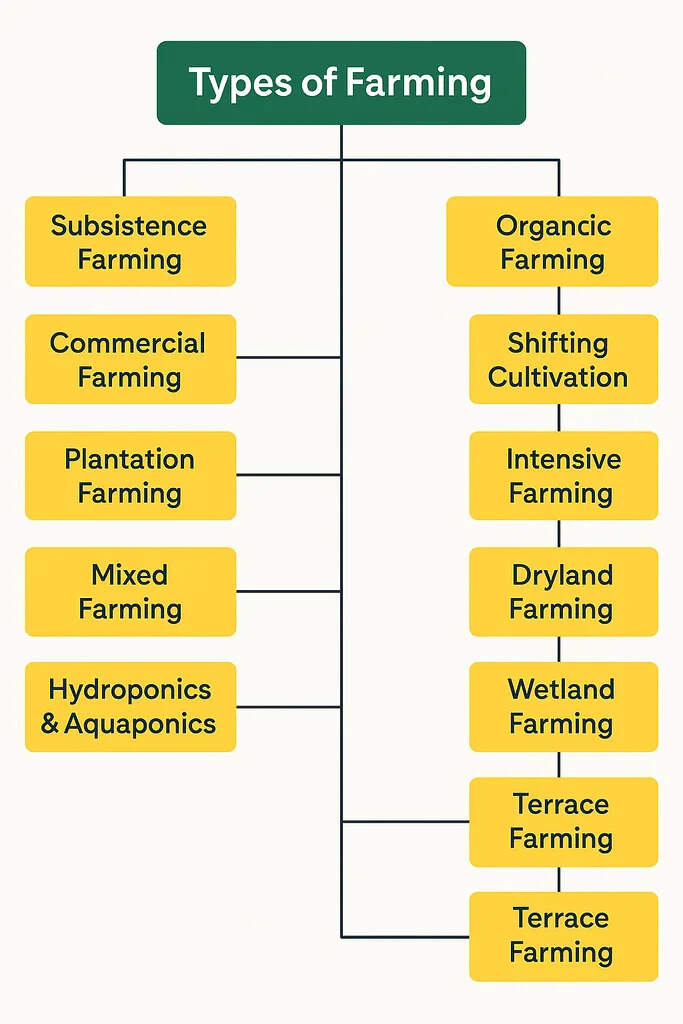
In 2025 we will see which Types of Farming and their Examples:
1. Survival farming
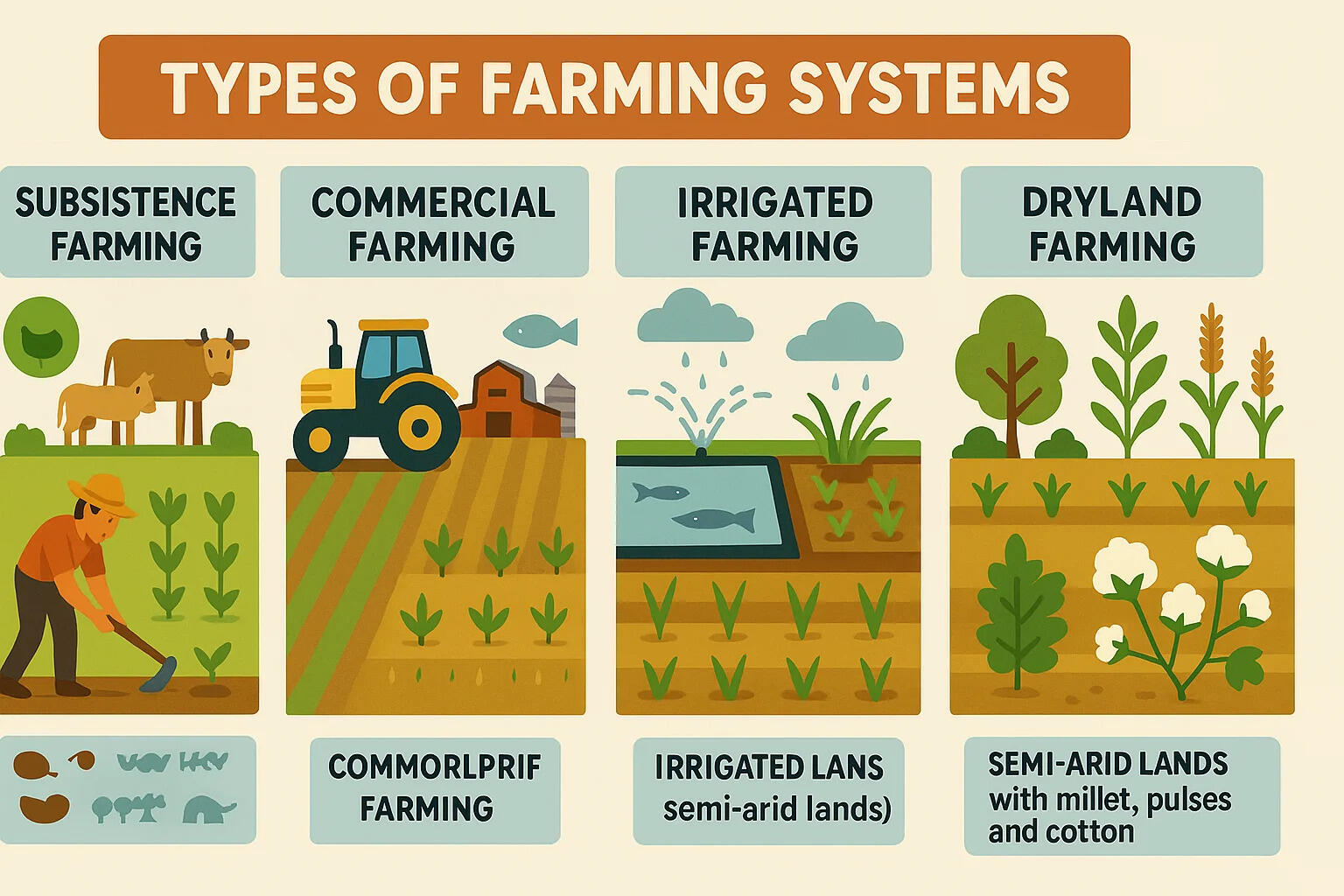
Subsistence farming, which is the oldest and most basic form of agriculture, sees farmers grow food mainly for their families’ consumption instead of for the market. In India, Nepal, and in parts of Africa, small-scale farmers still practice this. They grow rice, maize, wheat, and vegetables for use in the home.
Example in 2025: In rural areas of Assam and Ethiopia, families do subsistence farming to fulfill daily food requirements, which is not very market-oriented.
2. Agri-business
Commercial scale agriculture is into producing and marketing of crops and animals. It features the use of in depth technology, chemical inputs and large scale land use. Primary products, which include cotton, sugar cane, tea, coffee, and maize, are the main players in this field.
Example in 2025: Brazil’s soybean production and India’s large-scale sugarcane farms, which export to and meet the domestic demand of international and domestic markets.
3. Agroecology, which includes animal and plant production together
Mixed farming is a practice that includes crop production and animal rearing on the same farm. Also, this type of farming provides for diverse income and sustainability.
Example in 2025: In Europe farmers put out milk from dairy cows which they also use to grow wheat and maize. In India, farmers may practice paddy cultivation at the same time as raising goats or chickens.
4. Plantation Agriculture
Plantation agriculture is the practice of growing a single cash crop across large areas. It is very commercial and export-oriented, also mostly in tropical regions.
Example in 2025: Tea production in Assam and Darjeeling, rubber in Malaysia, and coffee in Brazil is seeing great success as global demand rises.
5. Extensive Farming on a large scale
Intensive farming is a practice that puts out large-scale food production from a small piece of land via the use of fertilizers, pesticides, irrigation, and high-yielding seeds. It is a common thing in areas of high population.
Example in 2025: In China and India, we see intensive cultivation of rice and wheat, which is done to meet the food requirements of large populations.
6. Large-scale farming
Intensive farming is the opposite of extensive, which is to say it uses large areas of land but puts minimal input into it, and is also a practice that is seen in sparsely populated regions.
Example in 2025: Australia’s sheep ranching and the large wheat farms of the Great Plains in the U.S. are examples of extensive farming.
7. Organized farming
Organic farmers eschew synthetic chemicals in favor of natural practices like composting, crop rotation, and biological pest control. As health and environmental consciousness grow, so does the organic food movement.
Example in 2025: Organic farms in California and Sikkim (India that is fully organic) supply to health conscious people world over.
8. Present-day and tech-based farming
This kind of farming uses drones, AI, hydroponics, and vertical farming. It is the result of a need to produce more food with fewer resources.
Example in 2025: In Singapore, we see the growth of vertical farms, which is also happening in Urban India; they are at the same time meeting city-level food requirements and doing so with very little land use.
Conclusion
In 2025, farming has a very wide range, which sees the coexistence of traditional methods with what is at the time state-of-the-art technology. From very small scale subsistence farming to large scale AI run vertical farms we see the evolution of agriculture in response to global issues. That which we see today in terms of types of farming is important in terms of what we as a world put out to support the farmers and the systems which, in turn, feed us. What will define the future of farming in the coming decades is the balance between sustainability and productivity.
About the Author