Transforming Creative Concepts Into Professional Audio Using AI Music Generator
The struggle to find the perfect soundtrack often delays creative projects, leaving many creators stuck between expensive licensing fees and generic royalty-free tracks that fail to capture a specific mood. Professional results usually require years of music theory or a significant budget, creating a barrier for independent artists and content creators. However, the emergence of a professional AI Music Generator offers a bridge between abstract ideas and studio-quality compositions, allowing anyone to translate their vision into sound without technical friction.
Modern creators are no longer limited by their ability to play an instrument or navigate complex digital audio workstations. By shifting the focus from manual production to intelligent guidance, this technology allows for a more fluid creative process. Whether you are building a brand identity or scoring a short film, the ability to generate tailored audio on demand changes the economics of digital storytelling.
Understanding The Core Architecture Of Modern Audio Synthesis Systems
The transition from simple MIDI loops to full-scale song production represents a massive leap in how we interact with digital media. Advanced systems now analyze thousands of musical patterns to ensure that the output feels organic rather than robotic.
The Role Of Deep Learning In Harmonic Structure
In my observations, the quality of AI-generated music depends heavily on the underlying model's ability to maintain rhythmic consistency. Unlike earlier tools that often produced disjointed melodies, current iterations excel at layering vocals and instruments in a way that sounds intentional. This makes it possible to produce tracks that stand up to professional scrutiny in various commercial contexts.
Bridging The Gap Between Lyrics And Melodic Arrangement
One of the most impressive aspects of this evolution is the Text to Music AI capability, which interprets the emotional weight of written words to influence the tempo and key of a track. By analyzing the sentiment of the input, the system can choose between a melancholic acoustic arrangement or an upbeat electronic pulse, ensuring the audio reflects the narrative depth of the lyrics provided.
Strategic Implementation Of AI Audio Tools For Content Creators
Integrating these tools into a professional workflow requires an understanding of both their potential and their current boundaries. While the technology is powerful, it serves best as a collaborative partner that handles the heavy lifting of arrangement and vocal synthesis.
Comparative Analysis Of Traditional And Intelligent Music Production
When evaluating whether to adopt new tools, it is helpful to look at how they differ from established methods in terms of accessibility and technical overhead.
| Production Aspect |
Traditional Studio Method |
ToMusic Intelligent Synthesis |
| Technical Skills |
Requires years of training |
Driven by natural language |
| Production Time |
Days or weeks per track |
Seconds to minutes |
| Vocal Integration |
Requires singers and equipment |
Built-in realistic vocal models |
| Customization |
High but labor-intensive |
Iterative and instant |
| Licensing |
Complex per-use agreements |
Royalty-free commercial options |
Navigating The Technical Limitations Of Automated Composition
It is important to remain realistic about the current state of the industry. In my testing, while the results are often stunning, they are highly dependent on the quality of the prompts provided. Sometimes, a system might require multiple iterations to perfectly capture a niche genre or a specific vocal inflection. Acknowledging these nuances helps creators build a more resilient production pipeline.
Streamlined Workflow For Generating Professional Audio Tracks
The process of moving from a blank page to a finished WAV file has been reduced to a few logical steps. Following the official platform logic ensures that the AI has enough context to produce the desired result.
Step One Defining Your Musical Direction
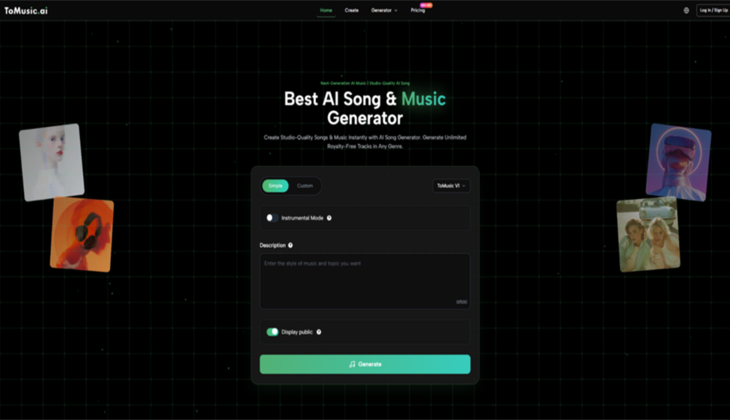
The first stage involves providing the system with the necessary raw data, which can be either a detailed description of the atmosphere or a complete set of lyrics. Users can choose between "Simple" and "Custom" modes to determine how much control they wish to exert over the final composition.
Step Two Selecting The Appropriate AI Model
Different projects require different levels of complexity. The platform offers multiple versions of its engine, from V1 for quick drafts to V4 for high-fidelity professional output. At this stage, you also determine whether the track should include vocals or remain a pure instrumental piece.
Step Three Generation And Post Production Refinement
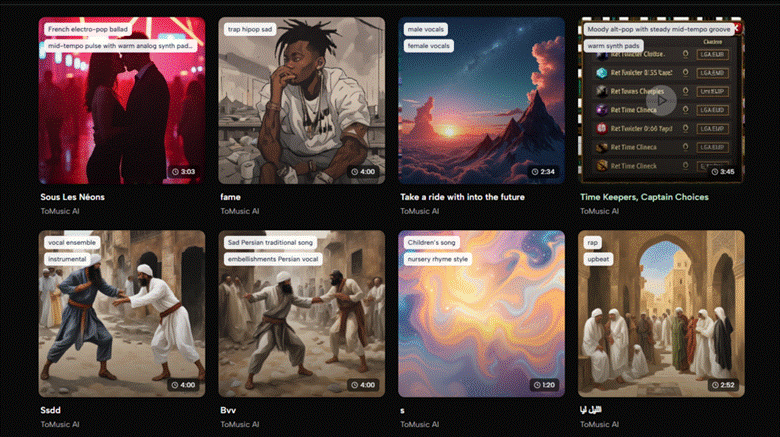
Once the parameters are set, the system generates the track in real-time. From there, professional users can utilize advanced features like vocal removal or stem extraction. This allows for further mixing in external software if the creator wants to blend the AI output with existing audio assets.
Expanding Creative Horizons Through Accessible Technology
The democratization of music production means that the "sound" of a brand or project is no longer a luxury reserved for those with deep pockets. By lowering the entry barrier, we are likely to see a surge in diverse musical expressions that were previously silenced by the cost of production.
Industry Trends And The Future Of Digital Audio
Research into AI audio indicates that the focus is shifting toward even greater user control. Future updates in the field are expected to offer more precise manipulation of specific instruments within a generated track.
Establishing A Unique Sonic Identity Without Technical Barriers
Ultimately, the value of these tools lies in their ability to let the user focus on the "what" and the "why" rather than the "how." By removing the technical friction of music theory and software mastery, creators are free to experiment with bold ideas, knowing they have a reliable engine to bring those ideas to life. This shift represents a new era where creativity is the only true currency in digital media production.