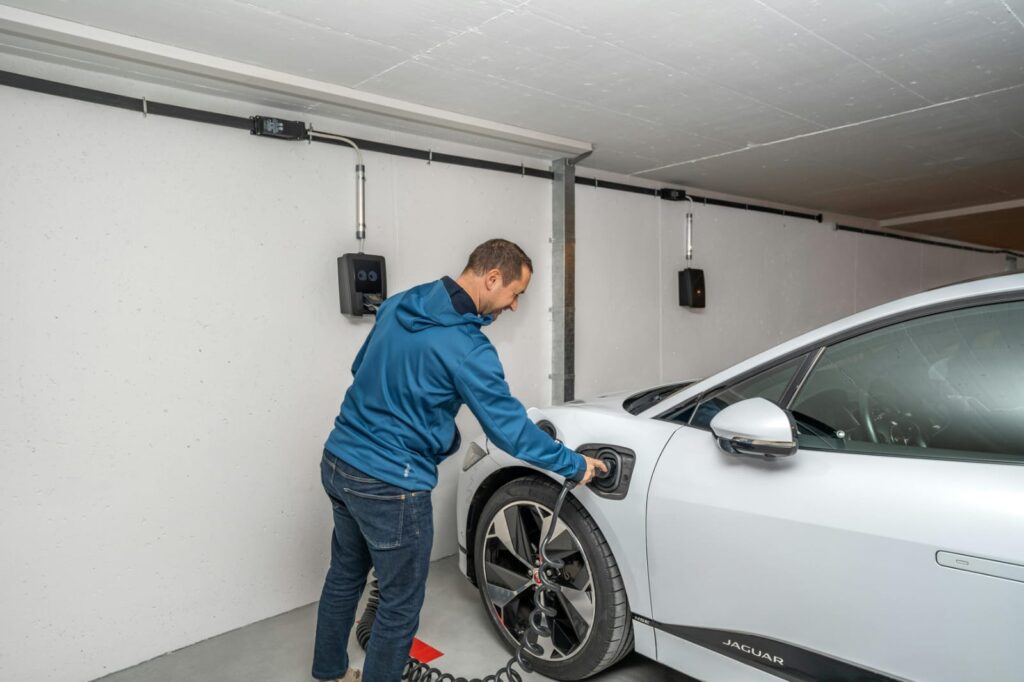
A Nissan Leaf from 2012 still runs. But its battery delivers maybe 55% of original range — not because of age, but because thermal management during charging was never optimised for real-world cycles. That single design gap cost owners hundreds of kilometres over time.
Engineers who worked on Gen 1 EVs weren’t bad at their jobs. Many of them had limited access to the kind of structured, data-generating lab work that exposes these failure modes before a product ships. The gap between knowing how a lithium cell behaves in theory and knowing how a 24-cell pack behaves at 2C discharge with passive cooling — that gap lives in the lab.
This is why what happens inside an ev lab matters beyond coursework. The experiments described below aren’t demonstrations. They generate real measurements on real hardware, and those measurements train the kind of engineering instinct that textbooks can’t.
Mapping Where Efficiency Actually Disappears
Most engineering students know that EV drivetrains are “more efficient than combustion.” Fewer can tell you where, specifically, the losses occur — and at what operating points they get worse.
A drivetrain efficiency mapping experiment fixes that. You run a motor-drive system across a grid of torque and speed setpoints, measure input electrical power and output shaft power at each point, and build a loss map. What usually comes out surprises people. At rated torque and moderate speed, a well-tuned AC drive reaches 88–92% efficiency. But drop to 20% load — which is where urban driving actually spends most of its time — and efficiency can fall to 75% or below. Iron losses dominate at high speed. Copper losses dominate at high torque. Neither textbook equation alone tells you where real vehicles operate most painfully.
A second experiment extends this into regenerative braking. Students configure the inverter for four-quadrant operation, apply controlled braking torques, and measure how much energy is recovered versus lost in switching, cabling resistance, and battery internal impedance. Recovery rates in lab conditions typically land between 60% and 75%. That number directly informs range-estimation models — and it shifts based on braking aggressiveness in ways that surprise even students who predicted it.
BMS Safety Tests: Inducing Faults on Purpose
Here’s the thing about battery safety experiments — the goal isn’t to watch something fail. It’s to confirm that the protection system catches the fault before damage occurs, and to understand exactly what triggers it.
Overvoltage testing is a good starting point. One cell in a multi-cell string is deliberately charged beyond its upper threshold while the BMS monitors the pack. Students record at what voltage the BMS triggers cell bypass or pack isolation, how long the response takes, and whether the alarm state latches correctly. The numbers matter. A 50ms response versus a 500ms response represents a real difference in how much energy a cell absorbs before protection kicks in.
Cell imbalance experiments reveal how balancing circuits actually work under load — not just at rest. An artificially imbalanced pack is cycled through several charge-discharge iterations. With passive balancing, students observe energy being bled off the high cells as heat. With active balancing, they measure charge being shuttled between cells. The difference in round-trip efficiency between the two methods is measurable and often larger than students expect — typically 3–6% per cycle in lab setups.
Thermal runaway isn’t something you induce in a student lab. But thermal derating is. Thermocouples at multiple pack locations during a sustained high-rate discharge let students observe how the BMS reduces current limits as temperature climbs. NREL’s battery safety research identifies thermal management as one of the most complex subsystems in modern Li-ion pack design — and the lab makes that complexity tangible rather than abstract.
Charging Experiments That Go Deeper Than “Plug In”
Charging looks simple from the outside. It looks very different when you’re measuring it.
A CC-CV profile characterisation experiment is foundational. Students program a charge sequence, then monitor current, voltage, temperature, and state-of-charge through the full cycle. The transition from constant-current to constant-voltage mode isn’t a smooth curve in real hardware — it has a small voltage overshoot as the controller adjusts. Catching that and understanding what causes it is exactly the kind of observation that doesn’t come from reading the datasheet.
Charging efficiency comparisons across power levels are equally instructive. Slow AC charging typically returns 88–92% of grid energy to the battery. DC fast charging can drop to 83–86% once you account for the onboard or off-board converter losses and the energy consumed by active cooling during the session. The U.S. Department of Energy’s Alternative Fuels Data Center documents these level differences, but the lab is where students see them produce actual numbers on their own test hardware.
For programs running a bidirectional EVSE setup, V2G experiments add another layer. The EV pushes power back into a simulated grid while students measure inverter THD, power factor, and reactive power compensation capability. IEEE Std 2030.1.1, which governs V2G communication and power quality, sets the benchmarks — and testing against those benchmarks is exactly the kind of structured ev lab work that prepares engineers for grid integration projects.
About the Author