
UI and UX are two important concepts in modern digital design. They are closely connected, but they focus on different aspects of how people interact with websites, mobile applications, software, and other digital products.
Understanding the difference between UI and UX design can be useful for students, aspiring designers, business owners, and anyone interested in technology and digital careers.
What Is the Full Form of UI?
UI stands for User Interface.
User Interface refers to the visual and interactive elements that users see and interact with when using a digital product.
UI design can include:
- Buttons
- Menus
- Icons
- Fonts
- Colours
- Images
- Layouts
- Forms
- Navigation elements
- Animations
For example, when you open a mobile banking application, the colours, buttons, icons, menus, and overall screen layout are all parts of its user interface.
What Is the Full Form of UX?
UX stands for User Experience.
User Experience refers to the overall experience a person has while using a product, service, website, or application.
UX design focuses on making a product:
- Easy to understand
- Simple to navigate
- Useful
- Efficient
- Accessible
- Convenient
- Satisfying to use
For example, if an online shopping website allows you to quickly search for a product, compare options, complete payment easily, and track your order without confusion, those aspects contribute to its UX.
UI vs UX: What Is the Difference?
The simplest way to understand the difference is:
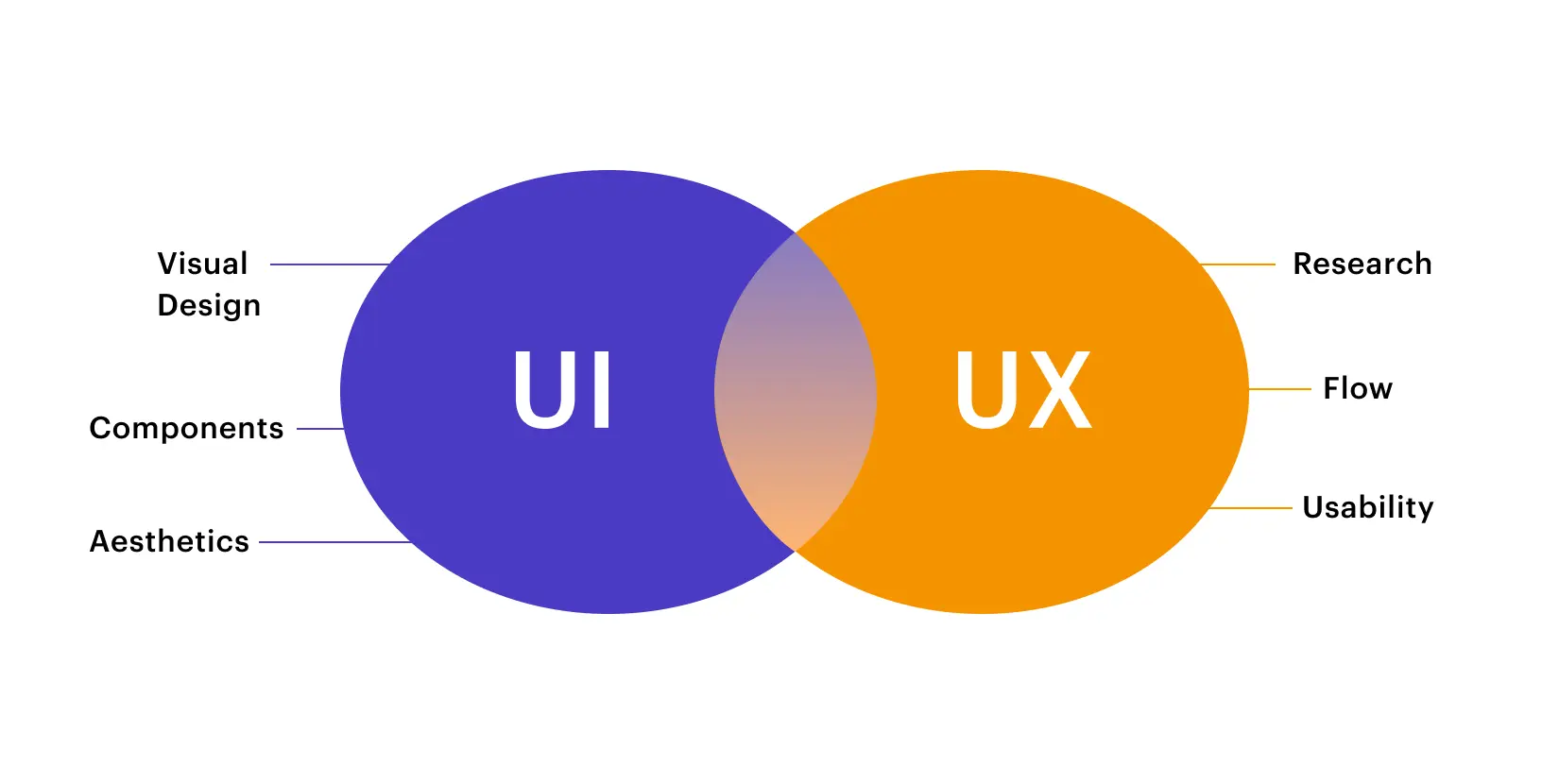
UI focuses on how a digital product looks and how its interactive elements are presented.
UX focuses on how the product works and how the user experiences it.
Consider a food-delivery application.
The attractive colours, restaurant images, buttons, icons, typography, and screen design are related to UI.
The ease of finding a restaurant, selecting food, placing an order, making payment, and tracking the delivery is related to UX.
Both work together to create a successful digital product.
Key Differences Between UI and UX
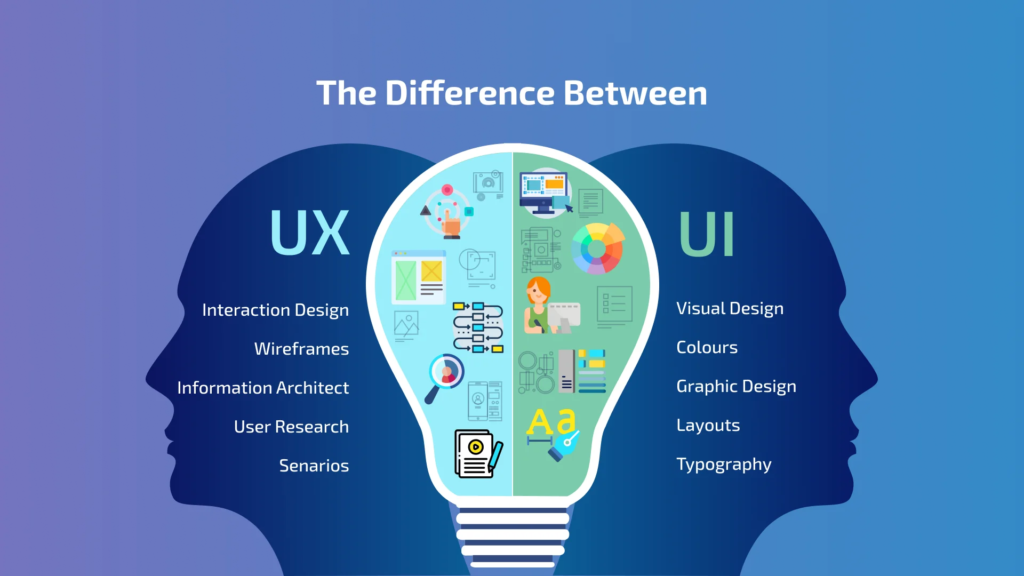
UI Design
UI designers primarily focus on:
- Visual appearance
- Typography
- Colours
- Icons
- Buttons
- Screen layouts
- Visual consistency
- Interactive elements
UX Design
UX designers primarily focus on:
- User needs
- User research
- Information architecture
- User journeys
- Navigation
- Usability
- Problem-solving
- Testing and feedback
Although their responsibilities can overlap, UI and UX are not exactly the same profession.
Why Does UI Design Matter?
A well-designed interface can make a digital product easier to understand and use.
Good UI design can help:
- Make information easier to find
- Improve visual clarity
- Create consistency across screens
- Make interactions more intuitive
- Strengthen a product’s visual identity
- Make digital products more appealing
A confusing or poorly organised interface can make even a useful product difficult to use.
Why Does UX Design Matter?
UX is important because users need more than an attractive interface. They need a product that actually solves their problem efficiently.
Good UX can help:
- Reduce user frustration
- Simplify complicated processes
- Improve navigation
- Make products easier to learn
- Identify problems before launch
- Improve customer satisfaction
- Encourage users to continue using a product
For businesses, a smoother user experience can also influence customer engagement and retention.
How Do UI and UX Designers Work Together?
UI and UX designers often collaborate throughout the product-development process.
A typical process might look like:
User research → Identify problems → Plan user journey → Create wireframes → Design interface → Build prototype → Test with users → Improve the product
UX designers may focus more heavily on research, structure, user flows, and usability, while UI designers concentrate more on the visual and interactive design.
In smaller teams, one person may perform both UI and UX responsibilities.
Is UI/UX Design a Good Career in 2026?
UI/UX design continues to be relevant as businesses increasingly rely on websites, mobile applications, software platforms, digital services, and other technology products.
People entering the field can explore roles such as:
- UI Designer
- UX Designer
- Product Designer
- UX Researcher
- Interaction Designer
- Visual Designer
- UX Writer
However, learning design tools alone is not enough. Employers and clients often look for problem-solving ability, design thinking, communication skills, usability knowledge, and a strong portfolio.
Skills Needed for UI/UX Design
A beginner can develop skills in areas such as:
- User research
- Wireframing
- Prototyping
- Visual design
- Typography
- Colour theory
- Information architecture
- Usability testing
- Design systems
- Communication
- Problem-solving
Familiarity with modern design and prototyping software can also be useful.
UI or UX: Which One Should You Learn?
Choose UI design if you enjoy:
- Visual creativity
- Colours and typography
- Layouts
- Icons and illustrations
- Creating attractive interfaces
Choose UX design if you enjoy:
- Research
- Understanding people’s needs
- Problem-solving
- Organising information
- Improving how products work
If you enjoy both visual creativity and problem-solving, learning both UI and UX can provide a broader foundation for a career in digital product design.
Final Thoughts
UI and UX are different but interconnected areas of digital design. UI focuses primarily on the interface and visual interaction, while UX focuses on the overall experience and usability of the product.
In 2026, understanding both areas can be valuable for anyone interested in digital products and technology. Rather than focusing only on making an application look attractive, successful design considers both how the product looks and how effectively it solves users’ problems.
Also read: https://amzn.to/4wpxv1h
About the Author