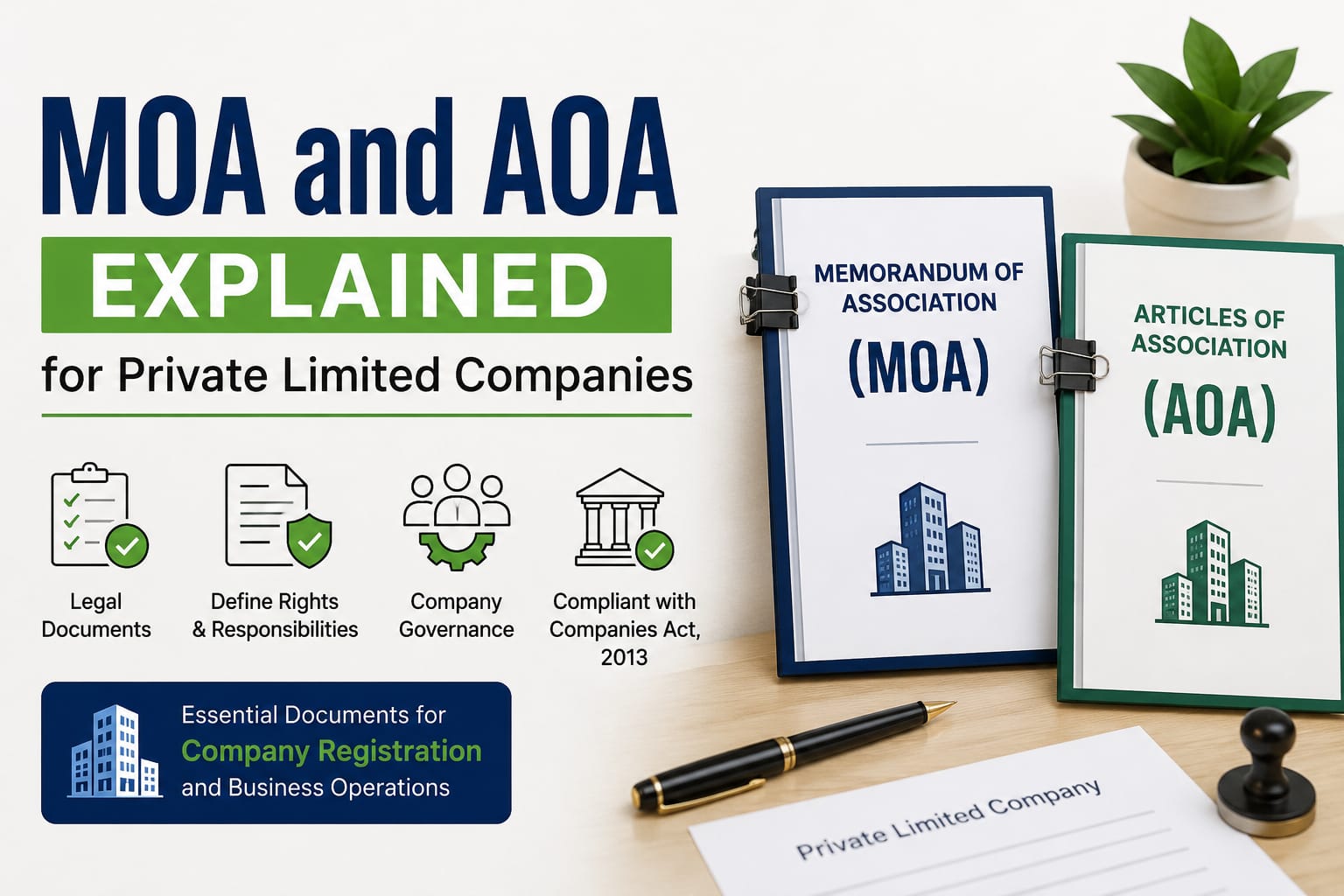
Ask any company secretary what causes the most incorporation delays, and you’ll likely hear the same answer, a poorly drafted Objects Clause in the MOA. It’s easy to see why, the Memorandum of Association and Articles of Association aren’t just formalities to tick off during registration; they’re the constitutional documents that define what your company can legally do and how it governs itself internally, for as long as it exists.
Yet most first-time founders treat these documents as an afterthought, copying a template without understanding what each clause actually locks in. A vague objects clause invites ROC queries and resubmission delays. An AOA that contradicts your shareholders’ agreement can create governance conflicts years down the line. Getting both right at incorporation is far cheaper than fixing them later.
In this blog, you’ll learn what the MOA and AOA are, the mandatory clauses each must contain, how they differ, the filing process through SPICe+, and common drafting mistakes to avoid.
What Is a Memorandum of Association (MOA)?
The Memorandum of Association (MOA) is the company’s charter document that establishes its legal identity, defines its relationship with the outside world, and sets the boundaries within which it can legally operate. Under Section 4 of the Companies Act, 2013, every company seeking company registration in India must prepare and file a Memorandum of Association (MOA) with the Registrar of Companies. Since the MOA is a public document, third parties dealing with the company are presumed to have notice of its contents, including the company’s stated objects.
The 6 Mandatory Clauses of an MOA
| Clause | What It Covers |
| Name Clause | The official company name; private companies must end with Private Limited |
| Registered Office Clause | The state where the registered office sits, determining ROC jurisdiction |
| Object Clause | The principal business activities and incidental activities necessary to achieve them |
| Liability Clause | Extent of members’ liability, limited by shares, by guarantee, or unlimited |
| Capital Clause | Authorised share capital and division of shares among promoters at incorporation |
| Subscription Clause | Names, details, and signatures of founding subscribers |
What is the most important clause in an MOA?
The Object Clause is considered the most critical, since the company cannot legally operate outside the activities stated within it. A poorly drafted objects clause remains the single most common reason SPICe+ applications get rejected, vague or overly broad wording invites ROC queries, while overly narrow wording restricts future expansion.
Did You Know? A private limited company needs a minimum of two subscribers to the MOA, a public company needs seven, and a One Person Company (OPC) needs just one, each subscriber’s signature is a binding legal commitment to acquire shares.
What Is an Articles of Association (AOA)?
The Articles of Association (AOA) is the company’s internal rulebook, governing how directors are appointed, how shares are transferred, how meetings are conducted, and how the company manages its day-to-day affairs. The AOA functions as a contract between the company and its members, and among the members themselves.
What Does an AOA Typically Cover?
Unlike the MOA, the AOA does not follow a rigid legal format, but it customarily includes:
- Share Capital and Rights, capital structure, classes of shares, and rights attached to each
- Appointment, powers, and removal of directors
- Procedure for board and general meetings
- Rules for share transfer and transmission
- Dividend declaration and distribution
- Winding-up provisions
What format does a private limited company’s AOA follow?
A private company’s AOA is typically based on Table F of Schedule I to the Companies Act, 2013, though it may adopt these model articles as-is or draft bespoke articles tailored to its specific governance needs, such as provisions from a shareholders’ agreement.
MOA vs AOA: Key Differences
| Aspect | MOA | AOA |
| Purpose | Fixes the company’s name, state, objects, and capital | Internal rulebook, director appointment, share transfer, meetings |
| Governing Section | Section 4, Companies Act, 2013 | Section 5, Companies Act, 2013 |
| Format | Rigid, 6 clauses in fixed order | Flexible, based on Table F or bespoke |
| Filed As | e-MOA, Form INC-33 | e-AOA, Form INC-34 |
| Alteration Process | Special resolution plus RoC/Central Government approval (Section 13) | Special resolution only (Section 14) |
| In Case of Conflict | Prevails over AOA | Any provision conflicting with the MOA is automatically void |
Can the AOA override a provision in the MOA?
NO. Where any AOA provision conflicts with the MOA, the MOA is given precedence, since the MOA defines the company’s external limits while the AOA governs internal management strictly within those limits.
How MOA and AOA Are Filed: The SPICe+ Process
- Reserve the company name via SPICe+ Part A on the MCA portal
- Choose the applicable table under Schedule I, most commonly Table A for the MOA of a company limited by shares
- Draft the MOA and AOA, ensuring all mandatory MOA clauses appear in the same fixed order
- File SPICe+ Part B, uploading the e-MOA and e-AOA along with subscriber details, director details, and registered office proof
- Affix DSCs of all subscribers and the authorised signatory, replacing physical signatures in most cases
- ROC verification, the Registrar issues the Certificate of Incorporation within 3 to 5 working days of submission, if satisfied
Fees: Government filing fees for e-MOA and e-AOA typically range from ₹500 to ₹2,000, depending on the company’s authorised capital.
How to Alter the MOA or AOA After Incorporation
| Change | Process |
| Altering the Object Clause | Special resolution + filing with ROC |
| Altering the Capital Clause | File Form SH-7 with the ROC within 30 days |
| Altering the AOA | Special resolution alone, under Section 14 |
| Altering the Registered Office (change of state) | Special resolution + Central Government/ROC approval |
Penalties for Operating Outside the MOA
Can a company be penalised for operating outside its stated objects?
YES. Any company operating outside the scope defined in its MOA risks penalties under Section 4(1)(c) of the Companies Act, 2013, imposed on both the company and defaulting directors.
Common Mistakes Founders Make
- Drafting an overly narrow or overly vague Object Clause, triggering ROC queries or restricting future business lines
- Adopting Table F articles without customisation, missing provisions needed to reflect a shareholders’ agreement
- Confusing an AOA management provision with an MOA objects clause, leading to internal inconsistencies
- Forgetting to file Form SH-7 within 30 days after altering the Capital Clause
- Assuming AOA amendments require the same Central Government approval as MOA amendments, they don’t
Pros & Cons of Adopting Table F vs Drafting Bespoke Articles
| Pros | Cons |
| Table F: Faster, ROC-familiar, fewer drafting errors | Table F: May not reflect specific shareholder arrangements |
| Bespoke AOA: Tailored to investor/founder agreements | Bespoke AOA: Requires careful legal drafting to avoid MOA conflicts |
Latest News
The MCA’s continued use of the SPICe+ V3 portal has streamlined e-MOA and e-AOA filing further, with DSC-based digital signing now standard for all subscribers, including foreign subscribers, who follow a slightly modified notarisation and apostille process before their signatures are accepted.
Quote
The MOA tells the world what your company can do. The AOA tells your company how it will do it.
Case Study
A Bengaluru-based SaaS startup drafted an overly broad objects clause during incorporation, listing over a dozen unrelated business activities to keep options open. The ROC flagged the application for clarification, delaying incorporation by nearly two weeks. On resubmission with a focused objects clause covering software development and related services, plus a standard ancillary objects provision for future expansion, the application was approved without further issue.
Conclusion
The MOA and AOA aren’t paperwork to rush through, they’re the documents that define what your company can legally do and how it will be governed for years to come. A well-drafted Object Clause avoids ROC delays and keeps room for growth; a thoughtfully customised AOA prevents governance disputes down the line. Getting both right at incorporation, rather than treating them as templates to copy, is one of the cheapest forms of insurance a new company can buy.
About the Author