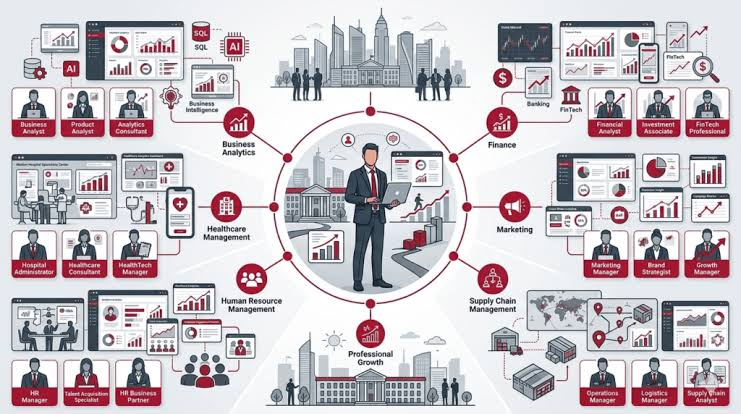

AI is disrupting careers in tech, business, healthcare, finance, and more. Understanding practical AI skills helps professionals adapt to an evolving workplace and improve their career prospects.
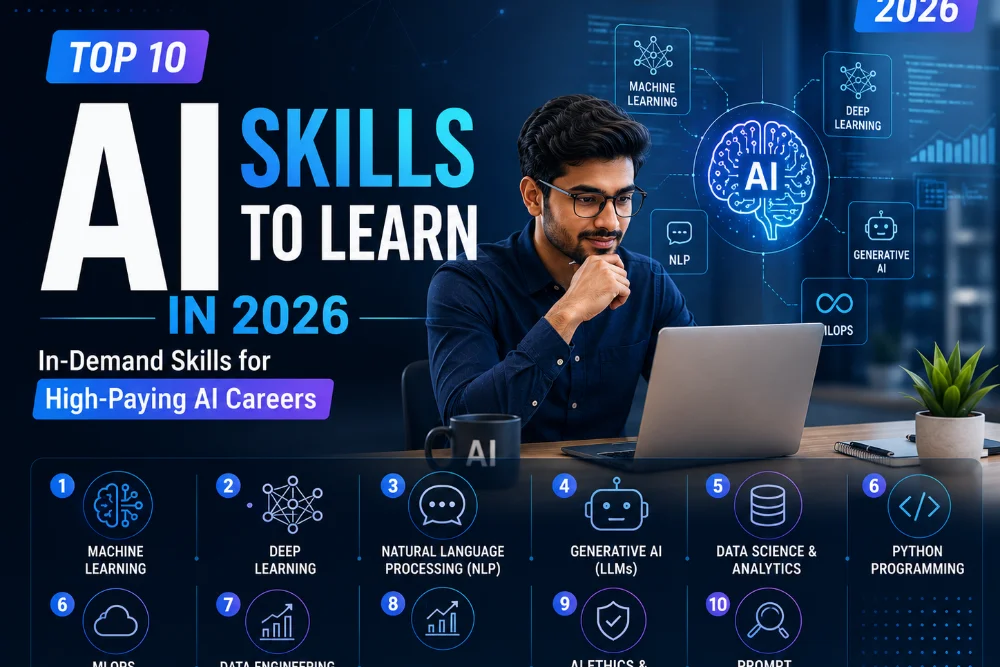
1. Generative AI
Generative AI refers to tools that can generate text, images, code, audio, and other content. Many professions are becoming relevant to understanding AI assistants and applications of generative AI.
2. Prompt Engineering
Prompt Engineering involves creating clear and effective instructions for AI models. It has the ability to provide more accurate, relevant, and useful results from AI tools for the user.
3. Automation and AI Agents
AI agents can execute multiple steps and automate workflows. Knowing how to build, run, and oversee AI agents is now very useful in today’s workplaces.
4. Machine Learning
Machine learning is a branch of computer science that uses algorithms and statistical techniques to predict patterns and make predictions based on data. Knowledge of Python, statistics, algorithms, and model evaluation can provide a foundation for an AI career.
5. Data Analysis
Quality data is crucial to AI. Data cleaning, analysis, visualisation, and interpretation skills are useful to help professionals extract insights from large datasets.
6. AI Programming
The significance of programming in the development and customization of AI applications. Educators can teach learners the fundamentals of AI development, including Python programming, APIs, and databases, to create functional AI solutions. Teachers can teach learners the basics of AI development, such as Python programming, APIs, and databases, to build practical AI solutions.
7. AI Cybersecurity
AI is providing new opportunities and new security issues. Call it as it is—security education for learning AI, threat detection, data protection, and secure system development can be beneficial to cybersecurity professionals.
8. Design of Responsible AI and Ethics
Responsible AI is about privacy, fairness, transparency, bias, and safe AI deployment. AI is increasingly being adopted in organisations, and it is crucial to understand these principles.
9. AI-Powered Productivity
AI can handle tasks like research, writing, customer support, and marketing/reporting. Workflows can be enhanced, and productivity increased if AI can be incorporated.
10. AI in Business and Industry
Information produced by AI should be verified prior to acceptance or application. Therefore, critical thinking, fact-checking, and evaluating AI outputs are significant skills that everyone using AI should have.
Conclusion
In 2026, AI skills are set to play a pivotal role in the job market. Some of the effective skills to acquire to work efficiently with emerging AI technologies include generative AI, prompt engineering, AI agents, machine learning, data analysis, programming, and critical thinking.
About the Author