
Know the Full Form of BTech: Course Details, Duration & Career Scope In 2026
Finished Class 12 in science and now everyone’s asking, “So, BTech or what?” Fair question. Before you sign up for four years of your life, you should actually know what the degree involves, not just that it sounds impressive on a resume.

What BTech Really Means
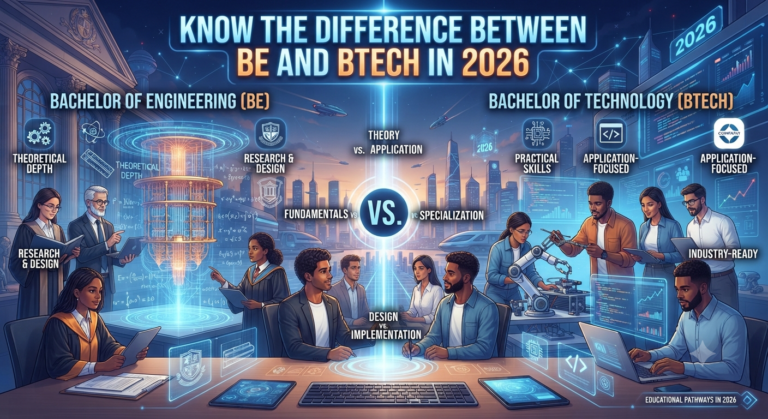
BTech stands for Bachelor of Technology. It’s a four-year undergraduate engineering degree, and honestly, the name gives away the point — it’s less about sitting through theory-heavy lectures and more about figuring out how to build, fix, or improve real things. Software, machines, infrastructure, data — pick a direction, there’s probably a BTech branch for it.
Then There’s BTech CSE
Walk into any engineering college canteen and someone’s talking about “CSE.” That’s Computer Science and Engineering — coding, algorithms, AI, data structures, the whole stack. It’s the branch most students gravitate toward these days, mainly because it opens doors into software jobs, IT roles, and analytics work almost immediately after graduation.
How Long It Takes and Who Can Apply
Four years. Eight semesters. Straightforward enough. Most colleges expect you to have cleared Class 12 with Physics and Maths, though the finer print differs from institute to institute. Getting in usually means clearing an entrance exam — JEE Main, a state-level test, or something specific to the college you’re eyeing.
Along the way, you’re not just stuck in classrooms. Labs, internships, and semester projects make up a big chunk of the experience, which is really the point — you’re supposed to walk out knowing how to actually do something, not just describe it in an exam answer. After that, options open up further: MTech, an MBA, or shorter certification programs if you want to specialize without going back for another full degree.
Why People Still Pick This Degree
Tech isn’t going anywhere, and neither is the demand for people who genuinely understand it. A BTech gives you the fundamentals and then throws you into situations where you have to use them — which is a decent way to learn, frankly. Add a short, focused course on top (AI, data science, whatever fits your interest), and you’re already ahead of most classmates who stop at the core curriculum.
The Usual Suspects: Specializations
- CSE — coding, AI, cloud, data science
- ECE — circuits, telecom, embedded systems
- Mechanical — machines, design, thermodynamics
- Civil — construction, surveying, structural work
- IT — software, databases, cybersecurity
Where People Actually Go to Study This
IIT Delhi, BITS Pilani, VIT Vellore, TMU Moradabad, NIT Trichy — these names come up again and again, and for good reason. Strong faculty, decent research exposure, and placement records that actually mean something.
What Happens After You Graduate
Software engineer, data analyst, project manager, developer — the usual list, and it’s a solid one. Startups, big tech, government roles, all fair game. Layer on some extra skilling in AI or cloud, and you’re looking at some of the faster-growing career paths out there right now.
At the end of the day, BTech isn’t magic, but it’s a genuinely useful starting point — and CSE, in particular, still opens more doors than most other branches combined.
About the Author