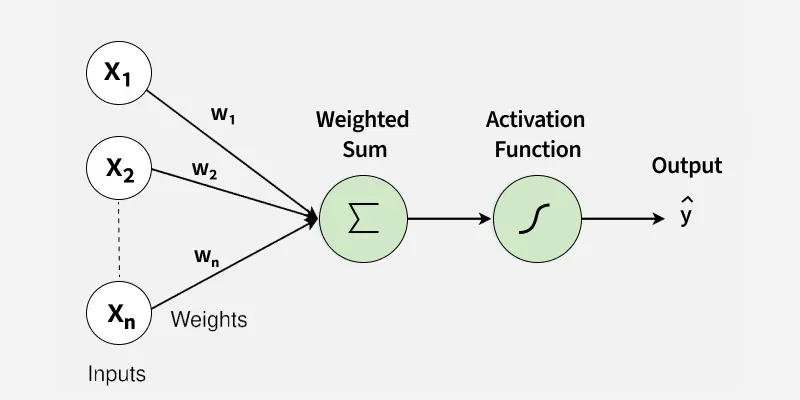

The perceptron is one of those old-school ideas in machine learning that just refuses to fade away. People have been talking about it ever since Frank Rosenblatt came up with it in the late 1950s. Basically, the perceptron is a simple supervised learning algorithm. Its job? To split data into two groups. Even with all the advanced AI tools around in 2026, the perceptron still matters—mainly because it’s so easy to understand and does a great job of introducing key concepts.
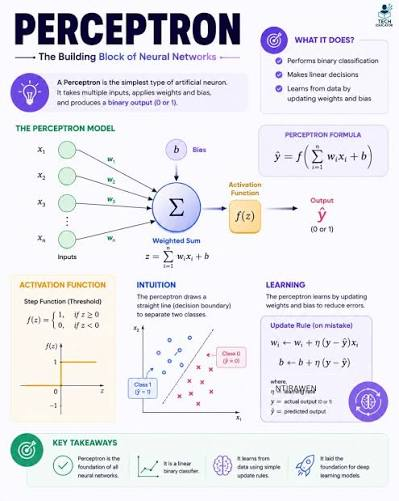
So, how does it work? Picture a bare-bones artificial neuron: you feed it a bunch of inputs, each input gets its own weight, you add a little bias on top, and out comes a single number. All you’re doing is adding up the weighted inputs, throwing in the bias, and running the total through an activation function that makes the final call. That’s really all there is to it.
In math-speak, it looks something like this:
Output = Activation (w₁x₁ + w₂x₂ + … + wₙxₙ + b)
Here, each x is an input feature, each w is its weight, and b is the bias. The perceptron’s original activation function keeps things simple—it just chooses between two outputs, like flipping an on/off switch.
What really makes the perceptron interesting is how it learns. During training, it checks its guess against the truth. If it’s wrong, it tweaks the weights and bias. Give it enough examples, and it draws a boundary—a line (or more complicated shape, in higher dimensions)—that tries to separate the groups.
The perceptron nails it when you have data that’s linearly separable, meaning a single straight line is enough to divide things. But if your problem is messier—like the famous XOR problem—the simple perceptron just can’t handle it. That’s what pushed researchers to stack multiple perceptrons, creating multilayer neural networks. With those, and a few smarter activation functions, you can handle much tougher problems.
Look under the hood of today’s deep learning systems and, honestly, the perceptron is still in there—it’s just been upgraded, layered, and given better tools.
In 2026, the perceptron’s main gig is teaching. It’s perfect for showing students what weights, biases, decision boundaries, and training are all about. If you’re solving real-world tasks like image recognition or language processing, sure, you’ll reach for something fancier. But plenty of folks start their journey right here.
When you get down to it, the perceptron is basic, but it’s got history. It lays out, in plain terms, how computers “learn” by nudging numbers around as they see more data. Even though machine learning has come a long way, the perceptron is still the best place to see how neural networks and deep learning get started.
About the Author