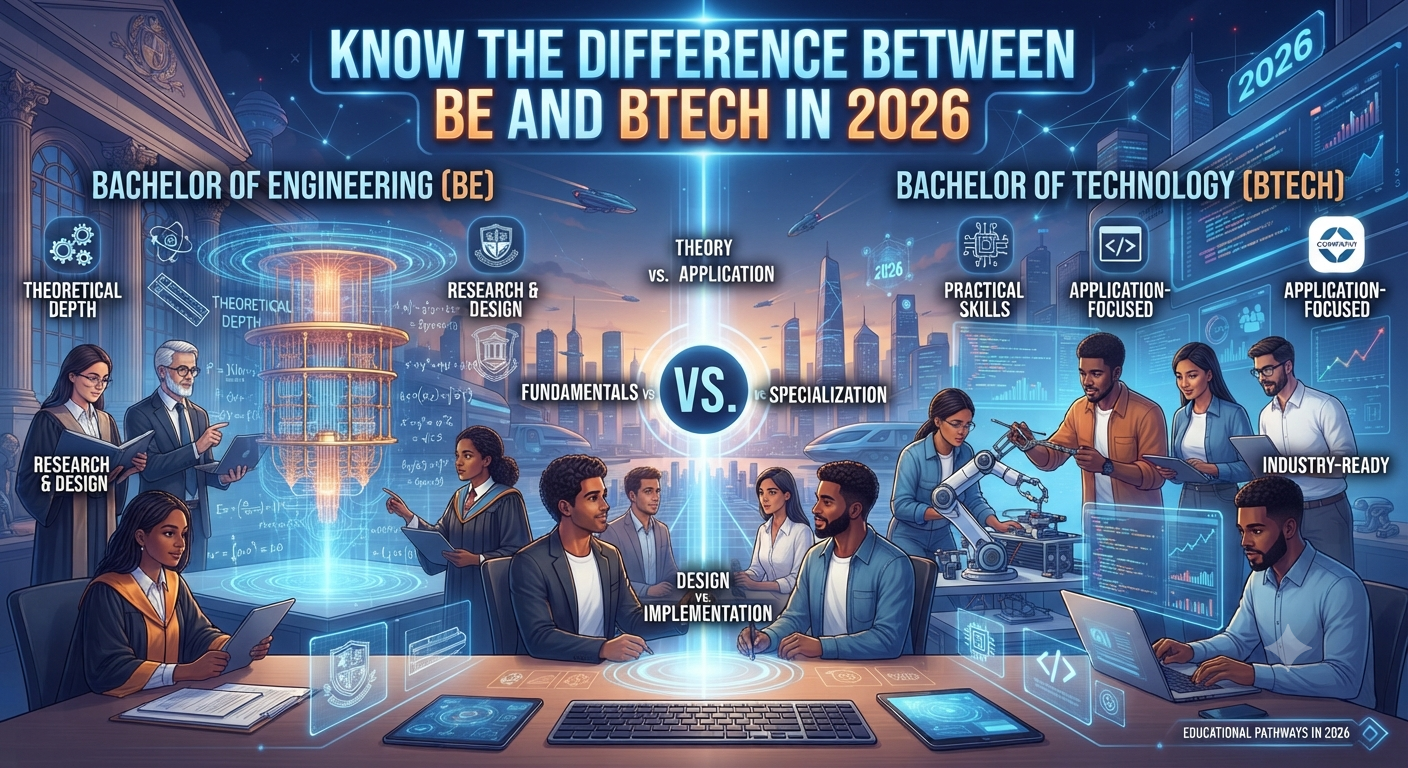

After Class 12, students are often confused when making a choice between two well-known engineering courses: Bachelor of Engineering (BE) and Bachelor of Technology (BTech). At first glance, they may seem completely different. In India, however, this difference is often much less than students would imagine.
Therefore, what’s the difference between BE and BTech in 2026? Most significantly, does the degree’s title have an impact on your career?
What Is BE?
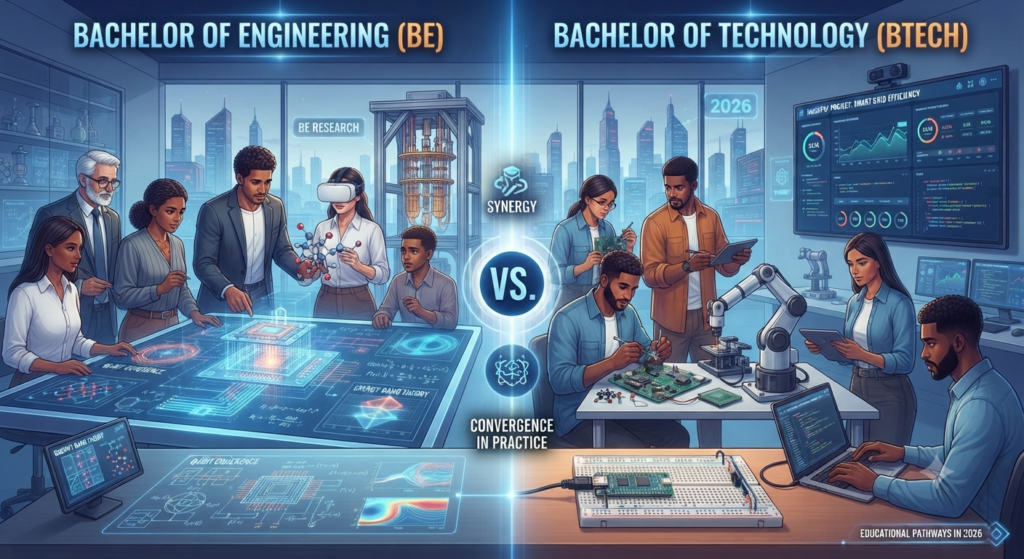
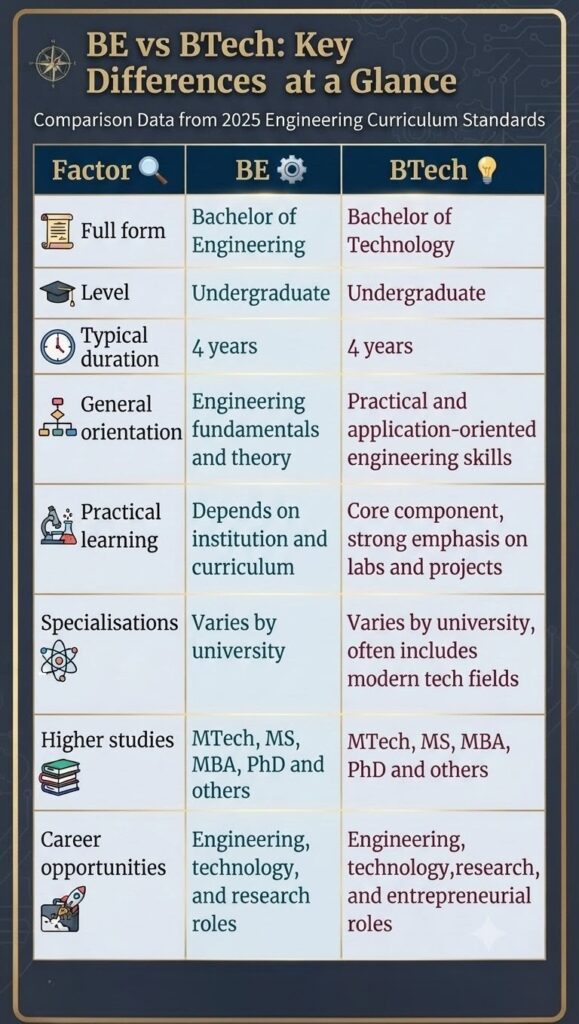
BE is an undergraduate Engineering Degree program. It’s a four-year undergraduate engineering degree typically offered by universities. Traditionally, BE programmes are more focused on the learning of basic engineering, mathematics, scientific concepts and theories.
The BE course can be pursued in various specialisations like Mechanical Engineering, Civil Engineering, Electrical Engineering, Computer Engineering and many more depending on the university.
It is incorrect to infer that all BE courses are theoretical in nature. Laboratory work, projects, internships and industry-oriented training can also form a part of the Modern BE programmes.
What Is BTech?
BTech is the acronym for the Bachelor of Technology. It is also a general four-year undergraduate engineering and technology course.
Application-oriented learning is associated with BTech programmes. Depending on the students’ specialisation, they can spend a lot of time on laboratory experiments, technical projects, programming, design exercises and other practical work.
BTech is offered in various specialisations like Computer Science and Engineering, Information Technology, Electronics and Communication Engineering, Biotechnology, Mechanical Engineering and many new technology programmes.
The current approvals of AICTE categorise the undergraduate Engineering and Technology programmes as four-year programmes and also offer lateral entry options under specific conditions.
Is BE More Theoretical and BTech More Practical?
One of the most frequently given answers is this, but it should not be taken as a rule of thumb.In the past, BE was seen as engineering theory, and BTech was seen as more application-oriented. In reality, the actual course content is very dependent on the university, college and individual programme.
A good BE course can offer a lot of practical exposure, and a good BTech course can have a lot of theory.
In the case of comparing two colleges, it will be better for the student to look into things like the syllabus, lab facilities, faculty, projects, internships, accreditation or approvals, placement details and industry exposure than just picking a college for the BE or BTech.
Does BE or BTech Have Better Career Opportunities?
Careers in engineering and technology can be pursued with either of the two degrees. Depending on their specialisation and skills, graduates can find employment in software development, manufacturing, electronics, construction, automotive industries, biotechnology, data-related industries, research and other industries.
The influence that your branch, college, technical skills, internships, projects and work experience can have on employment opportunities is significant.
A student studying Computer Science, for instance, can have a career in programming, software development, cloud computing or cybersecurity-related skills. In the meantime, a Mechanical Engineering graduate can pursue a manufacturing, automotive, design or creation position.
Therefore, the degree title alone does not determine someone’s career path.
What About Salary: BE vs BTech?
But there is no universal salary benefit just because a student has a BE qualification as compared to a BTech qualification, or vice versa.
The salary with which the first job is obtained depends on engineering branch, educational institution, area, employer, recruitment process, technical skills and experience. So two graduates may have two different offers, both for having different degrees but also for having comparable degrees.
Pupils must be careful with articles or advertisements that state that a higher salary is guaranteed if they have a certain degree.
Are BE and BTech Equally Recognised?
Recognition will only be granted where all the regulatory and legal requirements apply to both the institution and the programme. As per UGC, the statutory universities can confer specified degrees as per the requirements and regulations. UGC also states that the equivalence in higher education is granted by the university, and the employing organisation determines the equivalence in job-related areas.
AICTE also has frameworks in place for approval of technical education institutions and programmes.
It’s of special significance to point out that you should not assess an engineering programme based on its BE/BTech degree. Please read the institution and the programme thoroughly.
Which One Should Students Choose in 2026?
Students should focus on whether BE is better than BTech or whether BTech is better than BE rather than asking Is BE better than BTech?”
Which programme gives me the academic training, practical exposure and career opportunities I need?”
Before taking admission, compare:
- University and college reputation
- Exact engineering specialisation
- A revised curriculum or new subjects were introduced. A new curriculum / new subjects were added.
- Faculty and laboratories
- Internship and project opportunities
- Placement information
- Accreditation and applicable approvals- Fees and financial support
- Opportunities for higher education
- Location and campus facilities
This can prevent students from basing their choices solely on the names on their degree certificate.
The Bottom Line
BE and BTech are both successful undergraduate programs to enter engineering and technology in 2026. While this tradition of “BE is theory, BTech is practice” offers a general idea, it is not precise enough to be used to describe all programmes.
When a student asks “BE or BTech?” at the college admission counter or reads two college brochures, the more pertinent question is not just “BE or BTech?”. Don’t be misled by those three letters. Discuss priorities and objectives of what you will learn, where you will learn it, what practical opportunities you will have and how well the programme will fit your career plans.
The name of your degree is not the only factor that determines your engineering education.
About the Author