
Hill Climbing in AI: The Simple Trick Machines Use to Get Smarter
You’re hiking up a mountain in thick fog. You can’t see the summit, or much of anything past your own boots, so you do the only sensible thing: take a step, check if you’re higher than before, and if you are, take another. Keep doing that and eventually you stop climbing — either because you’ve reached the top, or because every direction from where you’re standing goes down. You often can’t tell which one it was.
That’s hill climbing. It’s one of the oldest optimization ideas in AI, and honestly one of the easiest to explain to someone who’s never touched a computer.
How it actually works
There’s no grand strategy here. You start with some candidate solution — could be random, could be a decent guess — and score it using whatever measure matters for your problem. Then you look at nearby variations of that solution, and if one of them scores better, you switch to it. Repeat. Stop when nothing nearby is an improvement.
It doesn’t remember where it’s been. It doesn’t plan ahead. It just keeps taking the best move available right now, which is both its charm and its downfall.
Why people still bother with it
Because it’s cheap, basically. No heavy memory requirements, no complicated setup, and it’s quick to run. A logistics company shortening a delivery route might start with some arbitrary ordering of stops, then just keep swapping pairs of cities whenever a swap shortens the total trip. A data scientist tuning a model might nudge the learning rate up or down and keep whichever direction improves validation accuracy. Warehouse scheduling, robot navigation, shift planning — hill climbing shows up in all of it, usually as a first attempt before anyone reaches for something fancier.
Where it falls apart
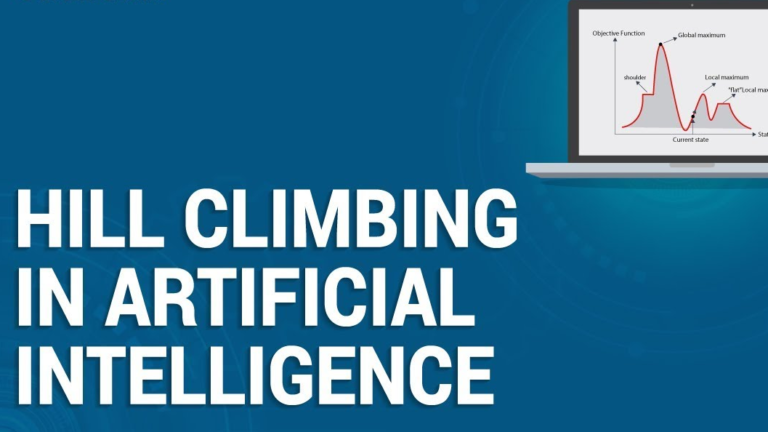
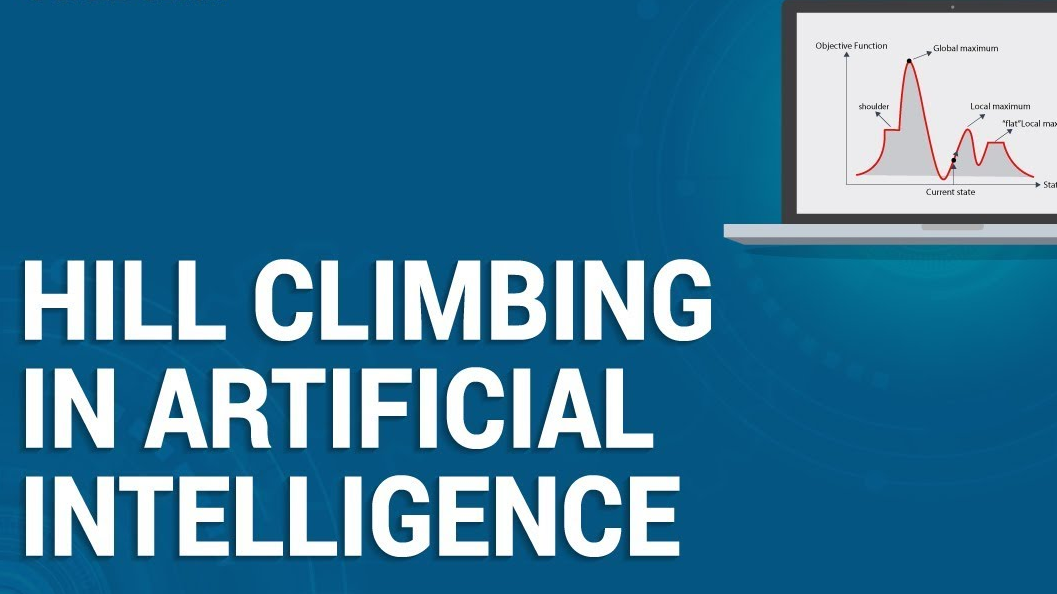
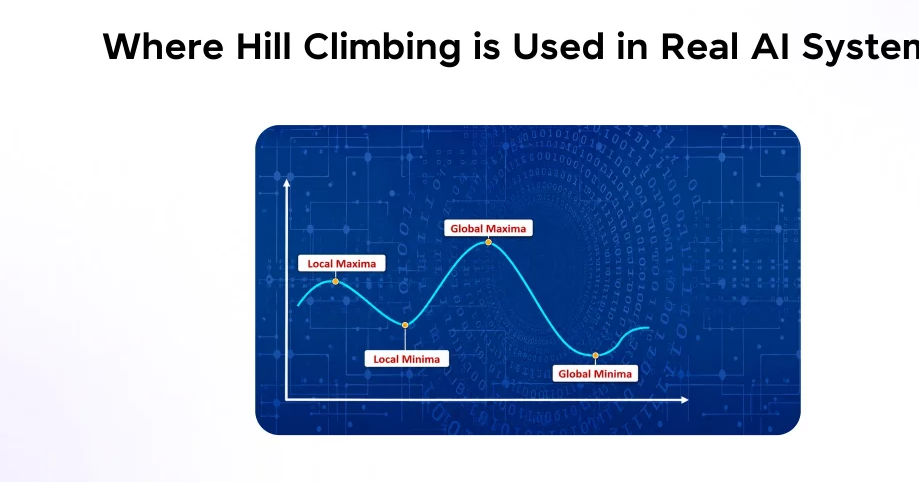
The obvious weakness: it can’t see past its own neighborhood. Climb the wrong hill and you’ll swear you’re at the top of the world, when really there’s a taller peak two valleys over that you’ll never find. That’s a local maximum, and it’s the algorithm’s most famous flaw.
Then there are plateaus — flat stretches where every nearby option scores the same, so the algorithm has no signal telling it which way to go. It can just sit there. And ridges are almost worse: a genuine path toward something better exists, but it zigzags in a way that doesn’t line up with the algorithm’s narrow definition of “neighbor,” so it stumbles even though the way forward is technically there.
And because there’s no backtracking, a bad starting point is often fatal. The algorithm has no way of knowing it wandered off in the wrong direction three steps ago.
Fixing the blind spots
None of this is fatal to the idea, though — people have been patching around these weaknesses for decades. Random restarts just run the whole thing several times from different starting points and keep the best result, on the theory that not every attempt will land in the same trap. Simulated annealing takes a different approach: it occasionally lets the search accept a worse move on purpose, which sounds counterintuitive but helps it escape dead ends it would otherwise be stuck in. Some people combine it with genetic algorithms or tabu search to give it something closer to memory.
About the Author