Buying car insurance in India usually comes down to two choices: third-party or comprehensive. Both are types of motor insurance, but they protect very different things. Understanding the difference between comprehensive and third-party insurance helps you pick the right cover for your car, your budget and your risk.
What Is the Difference Between Comprehensive and Third-Party Insurance? Quick Answer
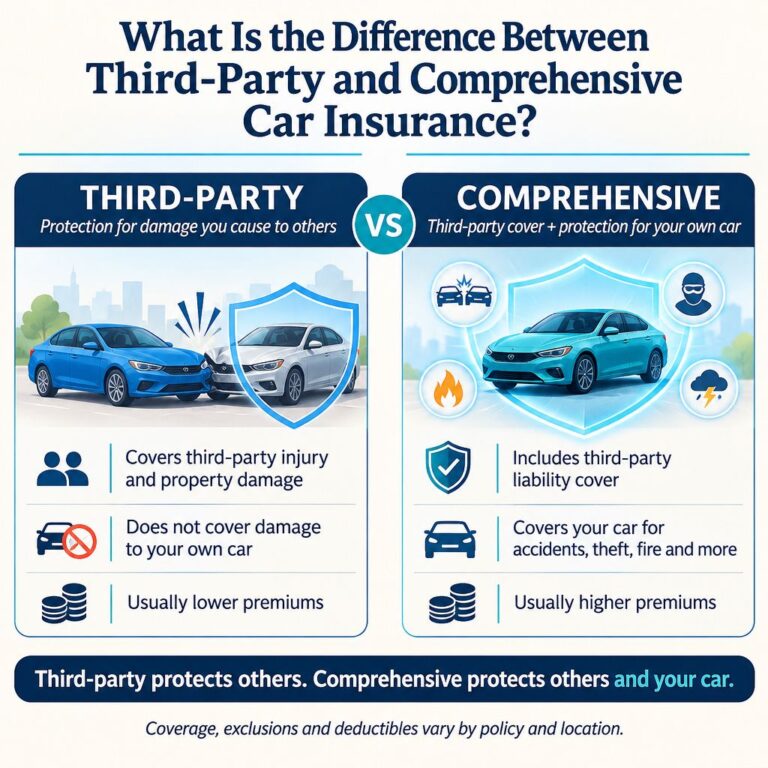
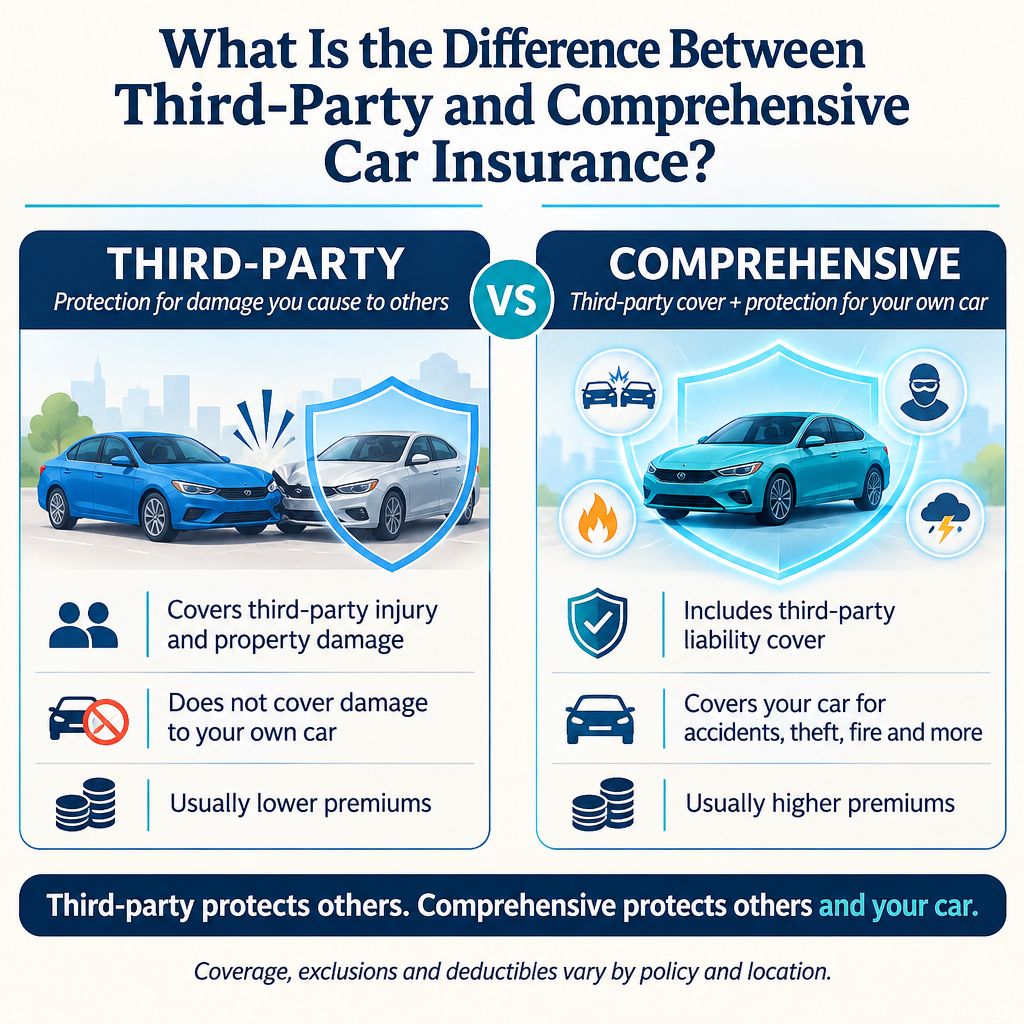
Third-party insurance covers the damage your car causes to other people, their vehicles or their property. It does not pay for damage to your own car. Comprehensive insurance includes third-party cover and also pays for damage to your own car from accidents, theft, fire and natural disasters.
In short, third-party protects others. Comprehensive protects others and you.
What Is Third-Party Car Insurance and What Does It Cover?
Third-party car insurance covers your legal liability towards others if your car is involved in an accident. The “third party” is anyone other than you (the policyholder) and the insurer.
It covers:
- Death or bodily injury to a third party
- Damage to a third party’s vehicle or property, up to ₹7.5 lakh
- Personal accident cover for the owner-driver, when included
It does not cover damage to your own car or its theft. Third-party premiums are set by IRDAI based on engine capacity, so they are the same across insurers.
What Is Comprehensive Car Insurance and What Does It Cover?
Comprehensive car insurance combines third-party liability with own-damage cover. It protects you against:
- Accidental damage to your own car
- Theft of the car
- Fire, explosion and self-ignition
- Natural calamities such as floods, cyclones and earthquakes
- Man-made events such as riots, strikes and vandalism
- Damage during transit by road, rail or water
- All third-party liabilities
The own-damage premium depends on your car’s Insured Declared Value (IDV), age, model and city. It also earns a no-claim bonus (NCB) of 20% to 50% for claim-free years.
Comprehensive vs. Third-Party Insurance: Side-by-Side Comparison
| Feature | Third-party insurance | Comprehensive insurance |
| Legal requirement | Mandatory | Optional, but includes the mandatory cover |
| Third-party liability | Covered | Covered |
| Damage to your own car | Not covered | Covered |
| Theft, fire, natural disasters | Not covered | Covered |
| Add-ons | Not available | Available |
| No-claim bonus | Not applicable | 20% to 50% on own-damage premium |
| Premium | Lower, fixed by IRDAI | Higher, based on IDV and car profile |
| Best for | Older, low-value cars | New, high-value or daily-use cars |
Is Third-Party Car Insurance Mandatory in India?
Yes. Under the Motor Vehicles Act, 1988, every vehicle on a public road must have at least third-party insurance. Driving without it can attract a fine of ₹2,000 and/or up to three months in jail for a first offence. For a repeat offence, the fine is ₹4,000.
New cars must also be sold with a three-year long-term third-party policy. Comprehensive cover is not legally required, but it is the only way to protect your own car.
What Is Standalone Own-Damage Cover and How Does It Fit In?
Standalone own-damage (SAOD) cover protects only your own car, with no third-party component. IRDAI introduced it in 2019 for car owners who already have a valid third-party policy.
It is most useful when your new car’s three-year third-party cover is still active. Instead of buying a full comprehensive policy each year, you renew only the own-damage part. You can also buy it from a different insurer than your third-party policy. Third-party plus standalone own-damage gives you the same protection as comprehensive motor insurance.
Popular Add-Ons Available with Comprehensive Motor Insurance
Add-ons can be bought only with comprehensive or own-damage cover:
- Zero depreciation: Pays the full cost of replaced parts, with no deduction for depreciation.
- Engine protection: Covers engine damage from water ingress or oil leakage.
- Return to invoice: Pays the car’s invoice value if it is stolen or totalled.
- Roadside assistance: Provides towing, flat-tyre help and fuel delivery.
- NCB protection: Keeps your no-claim bonus after a claim.
- Consumables cover: Pays for nuts, bolts, oil and coolant used in repairs.
- Key replacement: Covers lost or damaged car keys.
Which Car Insurance Should You Choose: Comprehensive or Third-Party?
Choose comprehensive car insurance if:
- Your car is new or high in value
- You drive daily or in heavy city traffic
- You live in an area prone to floods, theft or vandalism
- Your car is on a loan (lenders usually require it)
Third-party insurance may be enough if:
- Your car is old and its market value is low
- You rarely drive it
- You can comfortably pay for your own repairs
For most car owners, comprehensive cover offers better value. One major repair bill can cost far more than the premium difference.
How to Switch from Third-Party to Comprehensive Motor Insurance
- Switch at renewal. It is easiest to upgrade when your current policy is due for renewal.
- Compare plans. Check IDV, premium, add-ons, network garages and claim settlement records.
- Get the car inspected. Insurers usually inspect the vehicle, physically or by video, before adding own-damage cover.
- Submit documents. Keep your RC, previous policy and ID proof ready.
- Pay and download the policy. Your new comprehensive cover starts once payment and inspection are complete.
The right car insurance gives you legal compliance and peace of mind every time you drive.
About the Author