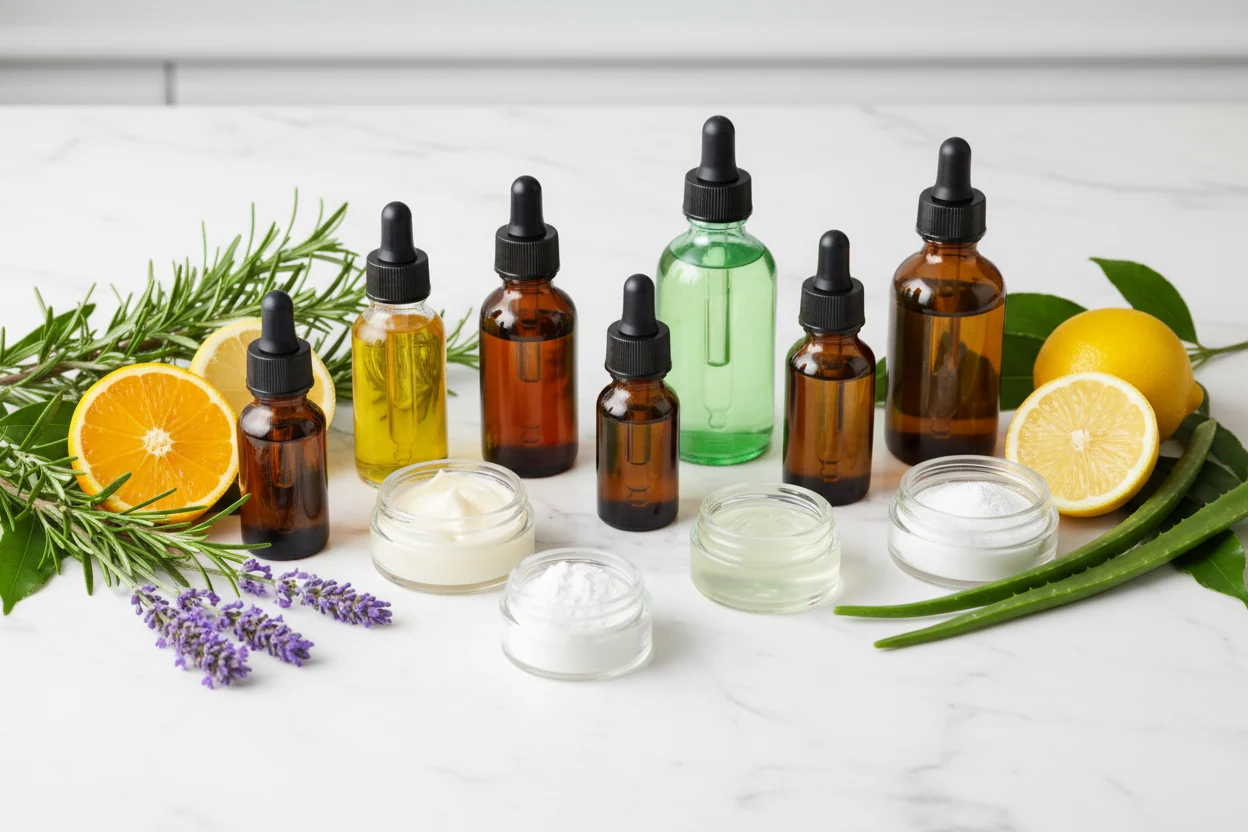
Just because a DIY skin care product smells and looks good, and has natural ingredients for the most part, that doesn’t mean it is safe for long term use. Products that include water, aloe vera, milk, or herbal extracts are ideal environments for bacteria, yeast, and mold to grow.
In my words, it is not true that homemade skincare is a practice left to natural ingredients. What is also important is to know how to keep those ingredients safe.
Here in 2026, we see a list of ten natural-origin preservatives and preservation ingredients that are worth knowing.
Benzoic acid salt.
Sodium benzoate is a preservative which is very much used in what we term natural cosmetic formulas. It’s a great agent which helps to repel the growth of certain bacteria, yeast and mold which in turn is seen mainly when the product has the right low pH.
It is a common ingredient in water-based products like facial cleansers, creams, and lotions. But do not add it randomly to homemade recipes. Its performance depends on the formulation’s pH and the overall preservation system.
Potassium Benzoate.
Potassium sorbate is known to control yeast and mold growth. It is a product of sorbic acid, which also appears in some berries in nature.
In your homemade lotions, gels, and other water-based preparations, potassium sorbate may be used. Also, it is important to note that this preservative does not perform the same against all types of bacteria. It may need to be used in combination with other preservatives, which will in turn provide better protection.
Benzyl Alcohol
Benzyl alcohol is a component that is present in some plants and is also used in the manufacturing of cosmetic products. It functions as an antimicrobial preservative and is included in a variety of cosmetic formulations.
It is a common ingredient that is used with dehydroacetic acid to provide better protection against microorganisms. For people with sensitive skin, it is important to pay attention to ingredient compatibility, as benzyl alcohol may cause irritation or breakouts in some.
Dehydroacetic acid.
Dehydroacetic acid is a natural preservative which is used in what we may term as traditional cosmetic products. It’s a component that helps in the protection of formulations against microbial growth which includes fungi.
It is a common practice to use in combination with benzyl alcohol, which, in turn, is a less common practice than isolating it as a single ingredient. This is a good tip when you are formulating your own lotions and creams, which, of course, is dependent on what the supplier says regarding use.
Gluconolactone.
Gluconolactone is a natural component of the polyhydroxy acid family. In cosmetic preservation, it is often used in conjunction with sodium benzoate.
We see this combination as protective of water-based formulations against microbial growth; it is also used in skin care products. But its performance is based on the finished product’s pH and formulation.
Sodium Levulinate
Sodium levulinate is a salt of levulinic acid, which we get from plant-based raw materials. It is used in some natural-origin cosmetic preservation systems.
It is a component which does help in the growth of microbes and also is put together with other elements to improve preservation. I would put forward that it is an interesting ingredient for people who are in the early stages of making cosmetic products from plants, instead of thinking that it is a stand-alone preservative for all homemade products.
Sodium Anisate
Sodium anisate is a product of anisic acid, which is related to aromatic plant materials. It is used in some natural skin care products for its antimicrobial action.
It is a special case when paired with other preservation ingredients. Also, its performance is a function of pH, concentration, and compatibility with other ingredients.
Caprylhydrazide.
Caprylhydroxamic acid is a versatile ingredient in today’s cosmetic preservation systems. It’s a great tool for controlling microbial growth and also plays a key role in formulations in which traditional organic acid preservatives do not perform as well.
It is a component that is used with other antimicrobial elements to improve overall preservation. Before use, formulators should check the technical instructions put forth by the supplier.
Glyceryl Caprate.
Glyceryl caprylate is a product of glycerin and caprylic acid, which in turn is obtained from natural fats and oils. It also serves to improve skin condition and to emulsify; it also has a role in fighting microorganisms.
It is a common use for it in combination with other preservatives instead of the sole preservative agent. It also does well in formulations that include oils and water.
Lactobacillus/Root of Radish Ferment Filtrate.
This ingredient is from the process of radish root fermentation with selected bacteria. It has become a hit among those who seek out natural skin care ingredients.
Although in some cosmetic products it is put forth as a natural preservative, its performance in that aspect is inconsistent. Also, do not assume that it provides full protection against bacteria, yeast, and mold until you have done the proper testing.
How to Select the Right Natural Preservative.
Choosing what preservative to use is based on the type of product you are making. For a homemade facial cream that contains water, we use one set of preservatives, and for an oil-based body butter, we use another.
Before you choose an ingredient, consider that:
Product type: Water-based gels, creams, and lotions require a good antimicrobial preservation system.
pH level: Some preservatives work best in a certain pH range.
Ingredient compatibility: A preservative must be compatible with other ingredients in the formulation.
Packaging: In a clean environment and with the use of airless pumps, contamination is reduced during everyday use.
Skin sensitivity: Natural ingredients can still cause irritation or allergic reactions.
One issue is that people think you can use vitamin E, rosemary extract, essential oils, or grapefruit seed extract in place of a full-scale cosmetic preservative. While vitamin E is great for reducing the oxidation of oils, it does not protect a water-based cream from bacterial and mold growth.
Final Thoughts
Natural skin care is out of which is the simple idea of avoiding synthetic ingredients. We are instead to think of a holistic approach which includes effective and safe products. Though we see value in natural-origin preservatives, we must also note that not all those from plant or other natural-based sources should be assumed safe or effective.
Personally, I think that beginners should put more into learning preservation techniques, which at present they are putting into making many at-home recipes. A homemade aloe vera gel may look and smell fine, which in turn may cause a person to think it is fine to use, but in reality it may be contaminated, which the beginner may not be able to tell.
About the Author