
How the Kaveri Shaped Kodava Bridal Traditions
A river’s parting gift, worn in every pleat and polished into every ornament
High on the eastern slopes of the Western Ghats, where mist clings to coffee estates and monsoon streams run fast, the Kaveri begins its long journey. The people who live around her birthplace in Kodagu, the Kodavas, have always seemed a little apart from their neighbours. They are a martial community with their own customs, their own dress, and a past nobody has managed to pin down. Some say they descend from stray soldiers of Alexander’s army. Others point to ancient travellers from the Middle East. Neither claim has ever been settled.
The river that turned the pleats
Local legend gives the most charming explanation for how Kodava women dress. The story goes that Kaveri, angry with her husband, the sage Agasthya, decided to leave him. The Kodavas begged her to stay. She refused, but promised to remain with them as a flowing river, feeding their fields and families forever. As she departed, the rush of her current is said to have twisted the pleats of the women’s saris around to the back.
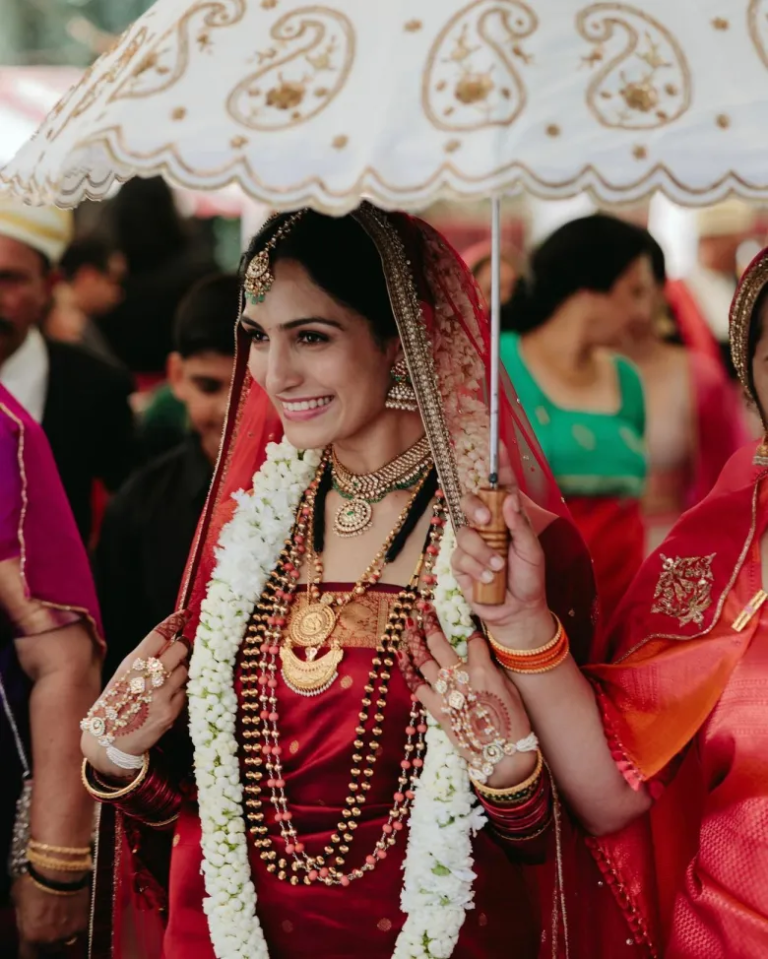
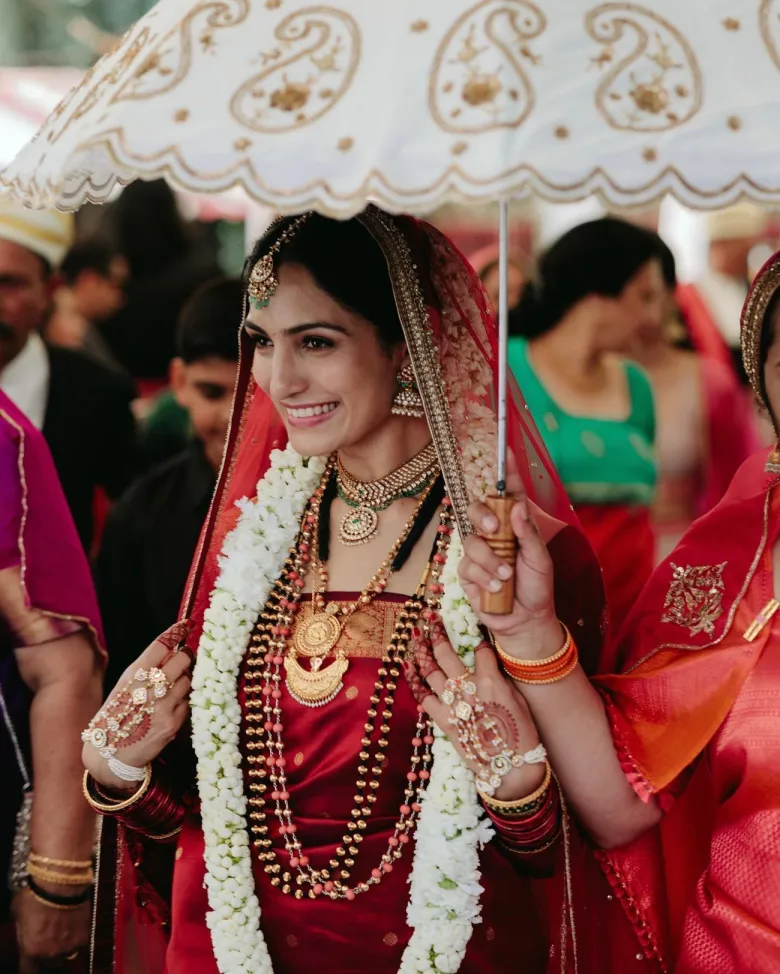
Women still drape the sari this way. The pleats fall behind, one end tucks under the left arm and gets pinned over the right shoulder. A bride completes the look with a long-sleeved blouse and a fine veil called the musku. Rich Benarasi silks in red to magenta are the favourite, and many brides borrow the sari of a mother or grandmother, kept safe for decades. Some families even pass down a great-grandmother’s veil, so thin it seems weightless yet strong enough to have attended generations of weddings.
There is a practical side too. With nothing loose to snag, the drape suits a people who once crossed dense forests on foot.
Gold shaped by nature
Kodava jewellery borrows from the world outside the door: sun, moon, serpent, leaf, and even the spiky skin of a jackfruit. Pieces are usually hollow, with delicate repoussé work hammered out from within. Gold and gemstones dominate, while silver is kept for the hands and feet.
Tradition asks a bride to wear seven of each kind of ornament, a tribute to the seven rishis who meditated at Talakaveri. Few modern brides manage the full count, but the spirit survives. The showpiece is the kokkethathi, a crescent pendant topped with a serpent, a figure of Lakshmi and two birds. Strangely, it resembles pendants from Oman, and even boat motifs from ancient Greek jewellery, which only deepens the puzzle of where the Kodavas came from.
Then there are the bangles, mostly oval for a snugger fit, including one modelled on bamboo joints and another on the jackfruit. The silver kaisara and kaalpili, with tiny rings linked by fine chains, are perhaps the most enchanting of all.
The groom, and his stand-in
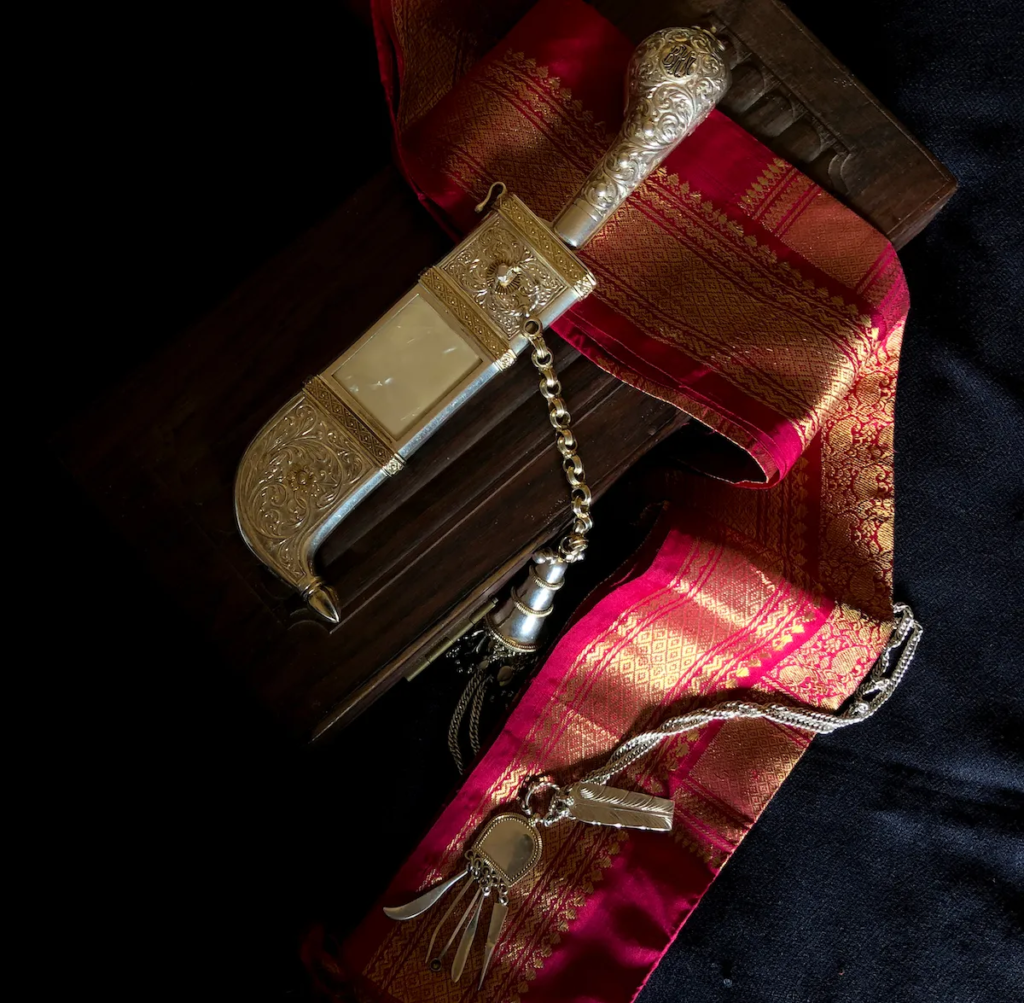
The groom looks like a man ready for anything. Over a white kupsa he ties a red brocade sash, tucks in a curved peechekathi heirloom knife, and carries a bell-trimmed ebony staff with a sharp tip. His war knife, the odi kathi, rests at his back in a heavy clasp.
The staff has one more role. If he can’t attend, it can stand in for him, carried by the best man so the ceremony proceeds. That custom dates from days when a man might be summoned to battle mid-wedding.
A living heritage
Today a Kodava wedding still unfolds over two days, ending with the gathering of family and clan. Guests will notice black-coated men and richly draped women, all of it quietly echoing a river that kept her promise.
About the Author