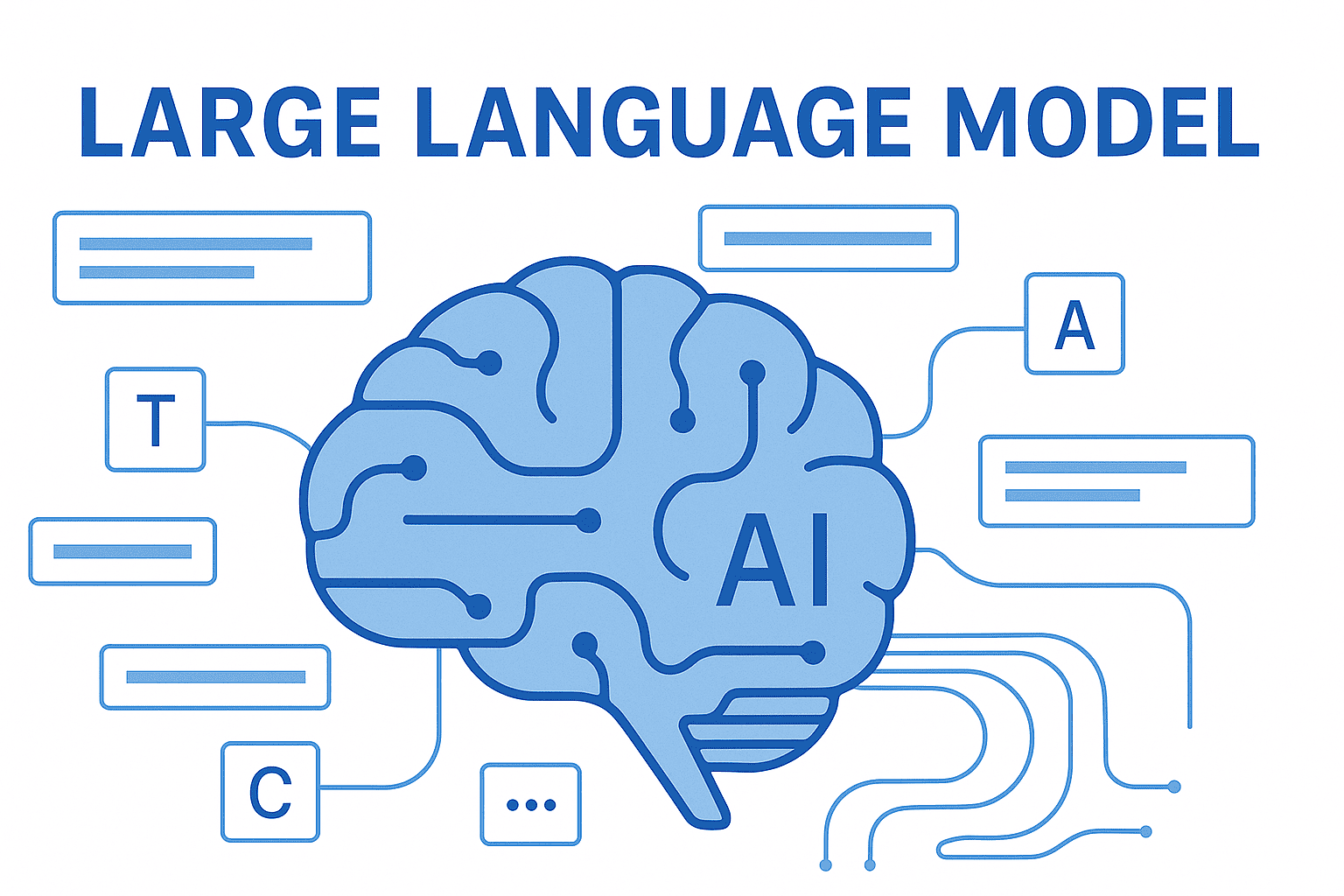

Large Language Models, commonly known as LLMs, have become a major part of artificial intelligence. They power many modern AI applications, including chatbots, writing assistants, coding tools, search systems, translation applications, and AI-powered business software.
But what exactly is an LLM, how does it work, and where is it used? Here is a complete guide.
What Is an LLM?
LLM stands for Large Language Model.
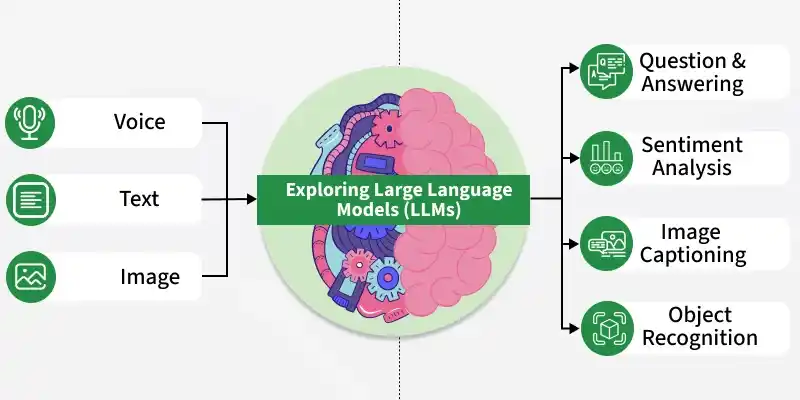
An LLM is a type of artificial intelligence model designed to understand and generate human language. It learns patterns from very large collections of text and other data and can use those patterns to produce responses to user prompts.
LLMs can perform tasks such as:
- Answering questions
- Generating text
- Summarizing documents
- Translating languages
- Writing and explaining code
- Creating content
- Extracting information
- Classifying text
- Generating ideas
- Supporting research and analysis
Examples of well-known LLM families include GPT, Claude, Gemini, Llama, and Mistral.
Also read: Top 10 Famous Romani People 2026
How Does an LLM Work?
At a basic level, an LLM learns relationships and patterns between tokens during training.
A simplified process looks like this:
Large Dataset → Training → Pattern Learning → Model → User Prompt → Generated Response
When a user enters a prompt, the model processes the input and predicts an appropriate sequence of tokens based on what it learned during training.
For example, if you enter:
“The capital of France is…”
the model can generate:
“Paris.”
Modern LLMs can perform much more complex tasks because they learn relationships across large amounts of language and other information.
What Are Tokens?
LLMs generally do not process text exactly as humans do. Text is divided into smaller units called tokens.
A token can represent:
- A complete word
- Part of a word
- A punctuation mark
- A number
- Other pieces of text
For example, a sentence such as:
“Artificial intelligence is changing technology.”
may be divided into several tokens before being processed by the model.
The exact tokenization depends on the model and its tokenizer.
What Is a Transformer?
Most modern LLMs are based on the Transformer architecture, which was introduced in the landmark 2017 research paper Attention Is All You Need.
Transformers use a mechanism called attention to determine how different parts of an input relate to one another.
For example, consider:
“The scientist put the sample in the refrigerator because it was cold.”
An attention mechanism helps the model determine relationships between words and understand the context of the sentence.
Transformers have become particularly important because they can process and learn complex relationships in large datasets efficiently.
What Is Attention?
Attention is one of the key mechanisms behind modern language models.
It allows a model to assign different levels of importance to different tokens when processing information.
A simplified example is:
“The researcher analyzed the sample because it contained unusual proteins.”
To understand the sentence, the model needs to connect words such as “sample” and “contained” with the surrounding context.
Attention mechanisms help establish these relationships.
How Are LLMs Trained?
Training a large language model generally involves several stages.
1. Data Collection
Large quantities of text and other forms of data are collected from appropriate sources.
The training data can contain different types of material, such as:
- Books
- Websites
- Articles
- Documentation
- Code
- Other digital content
The exact datasets and methods vary between models.
2. Preprocessing
The data is processed and prepared for training.
This can include:
- Removing unwanted material
- Filtering data
- Deduplication
- Tokenization
- Data quality checks
3. Pretraining
During pretraining, the model learns statistical patterns from large amounts of data.
A common training objective involves predicting missing or subsequent tokens.
Through repeated training, the model develops the ability to represent relationships between words, concepts, and patterns.
4. Fine-Tuning
A pretrained model can be further trained on specialized datasets to improve its performance for particular tasks or behaviors.
5. Alignment and Evaluation
Models may undergo additional training and evaluation to improve their ability to follow instructions, provide useful responses, and reduce undesirable behavior.
What Is Generative AI?
Generative AI refers to AI systems that can create new content.
They can generate:
- Text
- Images
- Audio
- Video
- Code
LLMs are a type of generative AI focused primarily on language and related tasks.
Therefore:
Generative AI → Broad category
LLM → Language-focused AI model
LLM vs Traditional AI
Traditional AI systems are often designed for specific tasks, such as:
- Fraud detection
- Recommendation systems
- Image classification
- Spam detection
LLMs are generally more flexible and can perform many different language-related tasks using natural-language instructions.
For example, the same LLM can potentially summarize a document, translate text, explain a concept, and generate code.
Applications of LLMs
LLMs are being used across many industries.
Education
LLMs can assist with:
- Explaining concepts
- Generating study materials
- Summarizing notes
- Language learning
- Personalized learning assistance
Healthcare and Life Sciences
Potential applications include:
- Literature summarization
- Medical documentation assistance
- Research support
- Information extraction
- Analysis of scientific text
Human and professional oversight remains important, particularly for medical decisions.
Software Development
LLMs can assist developers with:
- Code generation
- Debugging
- Documentation
- Code explanation
- Test generation
- Software development assistance
Business
Businesses can use LLMs for:
- Customer support
- Document processing
- Content generation
- Internal knowledge systems
- Report summarization
- Workflow automation
Research
Researchers can use LLMs for tasks such as:
- Literature exploration
- Summarizing papers
- Generating research ideas
- Extracting information from documents
- Assisting with coding and data analysis
What Are Multimodal LLMs?
Traditional language models primarily work with text.
Multimodal AI models can work with multiple types of information, such as:
- Text
- Images
- Audio
- Video
- Code
For example, a multimodal model may be able to analyze an image and answer questions about its contents while also processing written instructions.
This is an important direction in the development of modern AI systems.
Advantages of LLMs
LLMs offer several advantages:
- Ability to handle natural-language instructions
- Support for many different tasks
- Fast generation of text and code
- Ability to summarize large amounts of information
- Assistance with research and productivity
- Multilingual capabilities
- Integration into software and business workflows
Limitations of LLMs
Despite their capabilities, LLMs have important limitations.
Hallucinations
An LLM may generate information that sounds convincing but is incorrect or unsupported.
Knowledge Limitations
A model may not automatically know about events or information that occurred after its relevant training or knowledge period unless it has access to updated information.
Bias
Models can reproduce biases present in their training data or introduced through other aspects of model development.
Lack of Human Understanding
Although LLMs can produce sophisticated language, their operation should not automatically be interpreted as human-like understanding or consciousness.
Privacy and Security
Organizations need appropriate safeguards when using sensitive or confidential information with AI systems.
What Is Prompt Engineering?
Prompt engineering involves designing effective instructions for an AI model.
A good prompt can specify:
- The task
- Context
- Desired format
- Constraints
- Examples
- Expected level of detail
For example, instead of asking:
“Explain climate change.”
a more specific prompt could be:
“Explain climate change to a high-school student in 300 words using three real-world examples.”
Clear instructions can make the model’s output more useful and consistent.
What Is RAG?
RAG stands for Retrieval-Augmented Generation.
RAG combines an LLM with an external information-retrieval system.
A simplified process is:
User Question → Retrieve Relevant Information → LLM → Answer
Instead of relying entirely on information learned during model training, the system can retrieve relevant documents or data and provide them as context to the model.
RAG is particularly useful for:
- Company knowledge bases
- Research documents
- Technical documentation
- Customer-support systems
- Frequently updated information
LLMs and the Future of AI
LLMs are becoming part of a broader AI ecosystem involving:
- AI agents
- Multimodal models
- Retrieval systems
- AI-powered search
- Robotics
- Automated workflows
- Coding assistants
- Scientific AI
- AI infrastructure
Future AI systems are likely to combine language models with external tools, databases, software applications, and specialized models.
Careers Related to LLMs
The growth of LLM technology has created or expanded several career paths, including:
- Machine Learning Engineer
- AI Engineer
- NLP Engineer
- Data Scientist
- Generative AI Engineer
- LLM Engineer
- AI Research Scientist
- Prompt Engineer
- MLOps Engineer
- AI Product Manager
Important skills include Python, machine learning, deep learning, NLP, transformers, APIs, databases, cloud computing, and model evaluation.
Conclusion
Large Language Models are AI systems designed to process and generate language by learning patterns from large datasets. Modern LLMs are largely built using transformer-based architectures and can perform a wide range of tasks, from writing and summarization to coding and research assistance.
As AI continues to evolve, LLMs are becoming increasingly connected with multimodal AI, retrieval systems, AI agents, cloud computing, and automation. Understanding how LLMs work and their limitations can help students and professionals make better use of this rapidly developing technology.
Also read: https://link.amazon/B03Gga9uw
About the Author