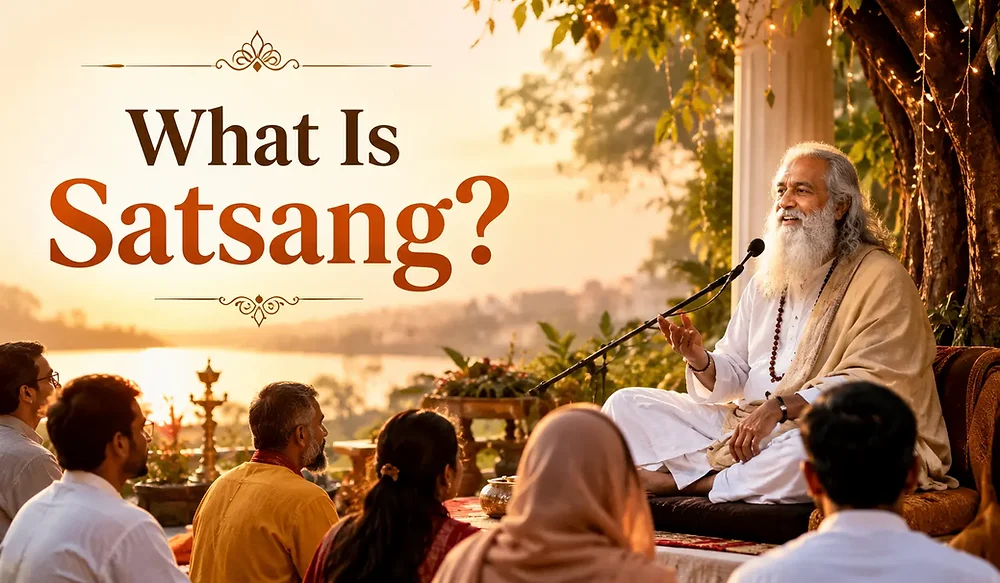

What Is Satsang, and Why Does It Matter in Religious Life?
Some of the most important moments in a spiritual life are not dramatic. They happen in a quiet room, among people who share a sincere search, while someone speaks or sings or sits in silence. That is satsang at its simplest.
The Meaning Behind the Word
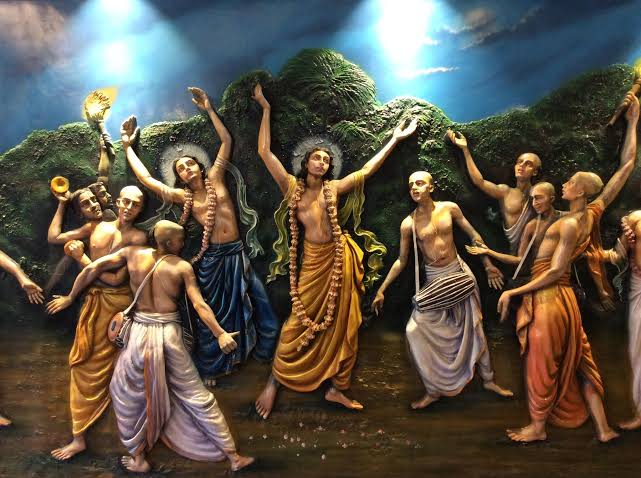
Satsang comes from two Sanskrit roots: sat, meaning truth, and sang, meaning company. Put together, it means keeping the company of truth. That company can be a teacher, a monk, a circle of devotees, a good book, or a thought about the divine that you hold onto during a busy day. Hindus, Buddhists, Jains and Sikhs all know the practice in some form, whether it shows up as a discourse, a hymn, a meditation or simple service to others.
At a deeper level, satsang is about staying close to sattva, the quality of clarity and calm. Indian philosophy describes three qualities in nature. Sattva brings wisdom and peace. Rajas brings restless ambition and ego. Tamas brings heaviness, dullness and negativity. Most of us are a mix, and the company we keep tends to tip the balance one way or the other.
Why Company Shapes the Seeker
The Buddhist texts say it plainly: choose virtuous friends, not corrupting ones. Bhikkhu Bodhi observed that a wise guide often becomes the deciding influence that wakes up our own hidden potential. Think of how a person who spends time with calm people begins to feel calmer, while constant exposure to bitterness leaves a residue. Satsang uses that ordinary truth on purpose.
Regular participation gradually quiets the senses and makes the mind more reflective. Ego loosens its grip a little. None of this happens overnight, and satsang alone cannot do the whole job, but it steadies the mind and supports the slow work of inner change.
Many Ways to Practice
Satsang is not limited to a hall full of people. Tradition describes several layers:
- Friendship with the self: turning attention inward and quietly observing the silent “I am” behind your thoughts.
- Friendship with pure thoughts: using discernment to feed the mind uplifting scripture and ideas rather than whatever noise arrives first.
- Friendship with good people: seeking out genuinely virtuous companions, while recognizing that even religious circles contain egotistical people.
- Universal friendship: extending compassion to every living being without expecting anything back.
- Friendship with God: worship, chanting, devotion and, at its peak, complete surrender.
A Practice for Modern Life
In a world crowded with distractions, this older idea feels surprisingly practical. Monasteries, ashrams, temples and gatherings have long kept spiritual aims alive for people whose days are consumed by work. And because satsang can be practiced alone, through reading, reflection or remembrance, it fits into ordinary routines.
The value of satsang is easy to state: you become like what you keep close. Choosing that company with care, whether it is a teacher, a friend, a verse or a quiet moment of inner attention, is one of the simplest ways to move toward a calmer and more purposeful life.
About the Author