

Today, mobile phones, laptops, cars, and many other gadgets have powerful computer processing capabilities even when they are very small. The technology that has been instrumental in changing the world by giving such capabilities to these gadgets is VLSI, which stands for Very Large Scale Integration. With VLSI, it is possible to put a lot of electronic components, especially transistors, in one circuit.
What Is VLSI?
VLSI means Very Large Scale Integration. This is a kind of semiconductor technique where the integration of several transistors or other electronic components in one silicon chip can be made.
In the past, when there were not many highly integrated circuits, all electronic circuits were composed of individual electronic components that would be wired together on a circuit board.
Today, VLSI technology forms the foundation of many processors, memory chips, controllers, and system-on-chip devices.
VLSI in Computer Engineering
In computer engineering, VLSI connects digital hardware design with computer architecture. Engineers use it to develop chips for processors, graphics processing, memory, embedded systems and specialized computing applications.
A chip can be designed around particular requirements such as processing speed, power consumption, physical size, and manufacturing cost. This makes VLSI important for both general-purpose computers and specialized electronic systems.
VLSI Design Flow

There are several steps in the design process of a modern chip. Even though the actual workflow depends on technologies and projects in question, the main steps include:
Specification: Specifications of chip functionality, performance, power restrictions, and other parameters are defined.
Architecture: Planning of architecture – functional blocks and communication between them.
RTL & Logical Design: Description of circuit functionality using hardware description languages like Verilog or VHDL.
Circuit Design: Creation and optimization of modules on the circuit level.
Physical Design: Placement of components and their interconnection using routing.
Fabrication: Fabrication of the final design using specialized fabrication processes on semiconductor wafers.
Testing and Packaging: Testing of manufactured chips and packaging for further use in electronic devices.
One should be careful about power, performance, and area (PPA) in all stages because the improvement of one parameter may affect another.
Major Types of VLSI Design
Digital VLSI
Digital VLSI deals with circuits processing binary data. Examples include processors, memory controllers, microcontrollers, and digital signal-processing systems.
Analog VLSI
Analog VLSI handles continuously varying electrical signals. Applications include amplifiers, sensor interfaces, voltage regulators and power-management circuits.
Mixed-Signal VLSI
Mixed-signal designs combine analog and digital circuitry on the same chip. They are particularly useful when physical signals must be converted, processed, and digitally controlled.
System-on-Chip (SoC)
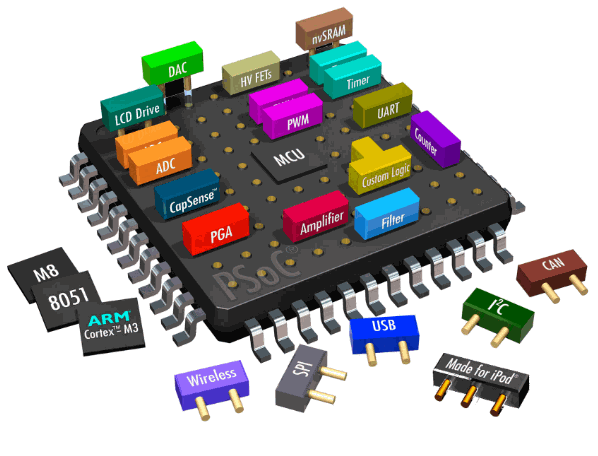
An SoC could be termed as an integrated circuit that comprises numerous functional units such as CPU, memory, data communication channels, and various accelerators. Highly developed SoC architecture is used in smartphones and embedded systems.
The use of VLSI technology is seen in a wide variety of sectors:
Consumer electronics: smartphones, tablets, laptops, TVs, and other handheld devices.
Automotive: vehicle control units, various driver-assistance systems, infotainment, and electrical circuitry for electric vehicles.
Telecommunication: cellular communication equipment and other tools for processing signals.
Healthcare: imaging equipment, monitoring gadgets, and portable devices for diagnostics.
Industrial automation: controllers, sensors, robotics, and IoT devices.
Aerospace and defense: Navigation, communication, and embedded computing systems.
Why Is VLSI Important?
The advent of VLSI technology has made it possible for the electronics industry to incorporate more functions in smaller spaces. More integration will result in fewer independent parts required and improved system efficiency.
Jobs that one could get after studying VLSI will range from areas such as RTL design, verification, physical design, analog design, semiconductor test, and chip design. With the advances in the area of semiconductor technology, knowledge of electronics, digital logic, computer architecture, and hardware description language would make for a good base for VLSI.
About the Author