

The theme of guns and grass connects two different worlds – a very old story from the Mahabharata and modern issues related to firearms.
On the one hand, guns and grass have nothing in common. While grass symbolises nature, peace and simplicity, guns stand for power, security and destruction.
But there is a story where a seemingly harmless thing turns out to be dangerous because of anger and arms.
This story from the Mahabharata is quite relevant to discuss in 2026 since nowadays people argue over firearms, responsibility, and violence.
The Story of Guns and Grass in the Mahabharata
The Mahabharata tells lots of stories about human nature, moral issues, power and the consequences of personal actions.
There is a little-known story in the book about the destruction of the Yadava clan, which was a strong community including Lord Krishna himself.
According to the epic, the Yadavas decided to go to Prabhasa, a holy coastal area, because of some unusual events in the state.
While gathering there, the members of the Yadava clan started to disagree on something.
Arguments led to anger, and the discussion of the problem transformed into a fight.
How Grass Became a Dangerous Weapon

One of the most amazing aspects of this tale is that common grass turned into lethal weapons.
According to the conventional version of the tale, the Yadavas started using grasses called Eraka, which became as dangerous as iron sticks.
This change occurred due to a curse and the circumstances preceding the annihilation of Krishna’s family.
As the conflict progressed, the combatants started attacking each other with the mentioned weapons.
Their rage and drunkenness made the situation only more out of control.
In the end, this fight led to the demise of many members of the Yadava tribe.
In this story, it becomes clear how unbridled emotions and weapons can destroy any small quarrel.
The Tragic Downfall of the Yadavas
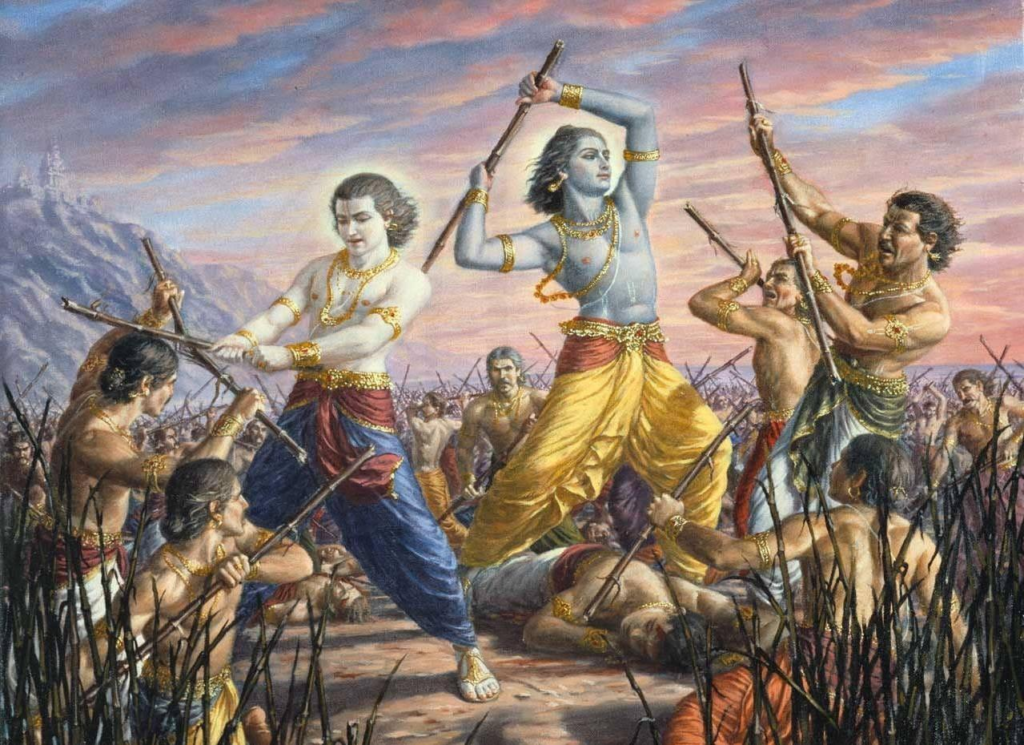
The downfall of the Yadavas is seen as one of the most emotional events in relation to the end of the mortal life of Lord Krishna.
The Yadava clan was once known for its power and association with Lord Krishna.
Nevertheless, internal disputes and their destruction of things eventually caused their doom.
This incident is typically followed by Krishna leaving the world after being shot by an arrow from a hunter called Jara.
Together, all these events signify the end of an important episode of the Mahabharata.
The tragedy shows that even a strong community suffers from anger, pride and violence instead of wisdom.
The Relation Between Ancient Weapons and Modern Firearms
There is an interesting parallel between the events of the old weapon age and modern firearms.
While in the old legend, grass turns out to be a deadly tool due to its transformation into a weapon during the fight,
the same happens with modern firearms, which bring irreparable damage.
A moment of anger, fear or misunderstanding may lead to a situation that can never be repaired again.
This parallel makes people think about the connection between weapons and human emotions.
Also, one may raise a question if people are ready to deal with dangerous situations without violence.
Gun Violence and Public Safety
Issues concerning gun violence are still relevant today.
Incidents related to the use of guns have triggered debates on the issue of gun ownership, safety measures, background checks, and appropriate behaviour.
There are those who feel that guns are needed for protection and that possession of them should be considered an individual right.
The other side focuses more on the dangers posed by the availability of guns, especially their misuse.
And even today, it continues to shape the debate on the regulation of firearms.
The question now lies in ensuring that individual rights are protected while preventing any form of unnecessary harm.
The Importance of Responsible Gun Ownership

It is necessary for gun owners to understand the risks involved.
Some of the ways of ensuring safety from harm include training, the storage of the gun, and knowledge of the laws pertaining to guns.
Background checks are also significant in this debate.
Background checks are meant to prevent certain individuals from accessing firearms legally.
However, discussions still arise about the efficiency, reach, and implementation of different regulations.
No matter how politics view these issues, it is critical for ensuring public safety to avoid unnecessary damage.
The Importance of Controlling Anger
One of the most valuable lessons of this Mahabharata story is the importance of the ability to control one’s emotions.
Despite being skilled warriors, the Yadavas were doomed by their inability to handle their disputes wisely.
Thus, one should understand that great strength is useless without controlling oneself.
Disputes will happen in one’s life, but there is no need to act violently.
Communication, patience, and the ability to solve conflicts wisely can help avoid escalation of a dispute.
This skill becomes especially important if one uses weapons that can cause deadly damage.
What Do Guns and Grass Teach Us in 2026?
Weapons and grass are interrelated terms that offer people one of the oldest lessons on responsibility.
Though weapons and technology have evolved so much, emotions like anger, fear, and pride have not undergone any transformation in humans.
The Mahabharata is a lesson that man learns that just because he has power does not mean that he has wisdom.
Personal Favorite
The most fascinating part of the story of Guns and Grass for me is its striking comparison between grass and weapons.
How an old story can provoke questions relevant to contemporary life is very interesting to me.
The fact that anger may turn a conflict that could have been handled into a catastrophe is also quite significant.
It implies that sometimes it is more valuable to control one’s feelings than to prove one’s strength.
Conclusion
Guns and Grass links an old Mahabharata tale with the contemporary concerns regarding weapons, aggression and responsibility.
The fall of the Yadavas serves as an example of the destructive impact of uncontrolled anger and abuse of powerful arms.
In 2026, the story is still relevant since it teaches about the necessity of wisdom, prudence and peaceful communication in order to preserve human lives.
About the Author