

Indian Premier League (IPL) has achieved great popularity among some of the best cricket leagues of the world. From the very inception of the league in 2008, the T20 version of the sport has evolved into an event of huge sports entertainment for spectators.
The league stage is indeed an entertaining affair, but it gets more thrilling once the playoffs approach. Given the stiff competition between the teams for the coveted top four places, any victory or even an insignificant enhancement in net run rate starts counting. But how do the teams qualify for the playoffs? How does the playoff mechanism operate after the top four teams are determined?
Let’s examine the details of the IPL qualifications and playoffs.
How Do Teams Qualify for the IPL Playoffs?
The IPL now comprises ten teams, with all the teams playing fourteen matches each during the various stages of its operations. As the quantity of matches played by each team is not equal among all the teams, the scheduling in the league is formulated with extra precaution so that accurate standings can be acquired.
Teams receive two points for a win, while a match that ends without a result generally gives each side one point. A team receives no points for a defeat.
At the end of the league stage, all 10 teams are arranged according to their total points. If two or more teams finish with the same number of points, Net Run Rate (NRR) is used as an important tiebreaker.
The four highest-ranked teams in the points table qualify for the IPL playoffs. The other six teams are eliminated.
However, finishing in the top four does not mean every team has the same route to the final. The position in which a team finishes determines which playoff match it enters.
What Is the IPL Playoff Format?
The IPL follows a play-off format meant to favor those teams which have excelled in the league phase.
The four qualified teams are segregated into groups based on their seeding:
1 & 2 – Qualifier 1
3 & 4 – Eliminator
The play-off phase comprises Qualifier 1, Eliminator, Qualifier 2, and the Final.
One of the interesting features of this system is that the top two teams receive an additional opportunity to reach the final if they lose their first playoff match.
What Is Qualifier 1?
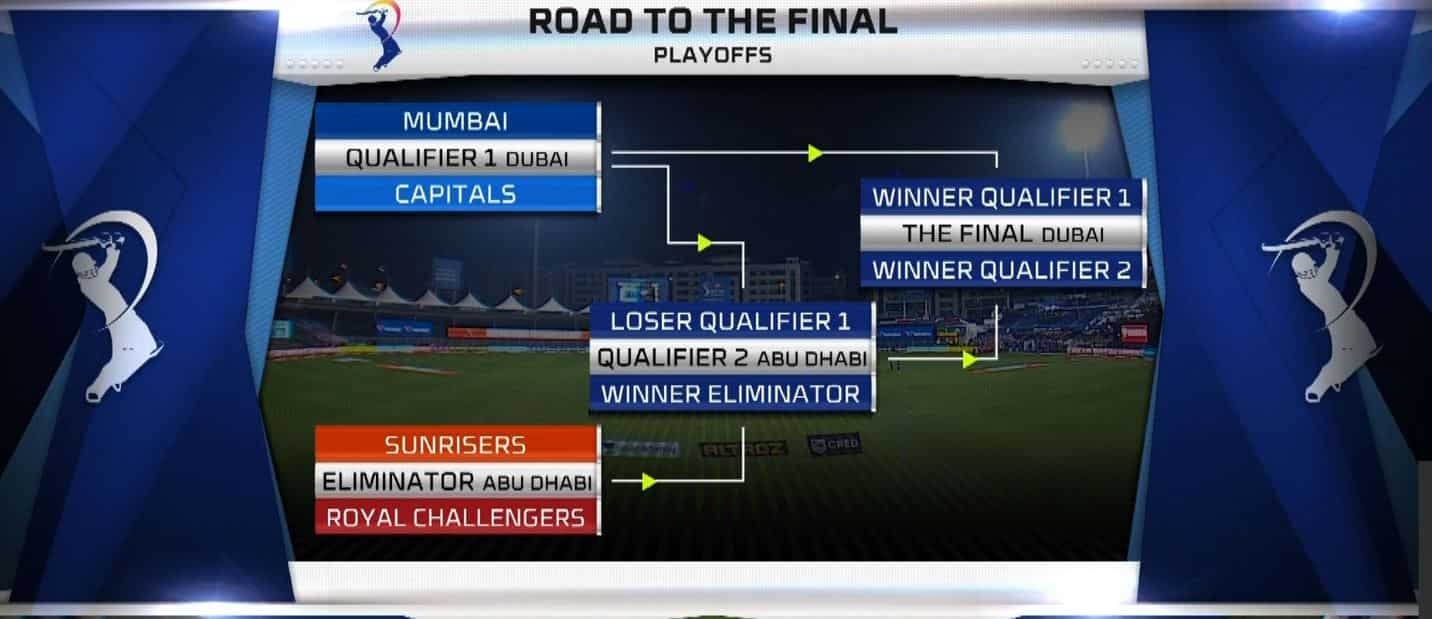
Qualifier 1 is played between the teams that finish first and second in the league standings.
The winner gets a direct ticket to the IPL Final. The losing team, however, is not eliminated. It receives another opportunity through Qualifier 2.
This gives the top two teams a significant advantage for performing well during the league stage.
What Is the Eliminator?
The Eliminator is contested between the teams finishing third and fourth in the points table.
Unlike Qualifier 1, there is no second opportunity for the losing side. The winner moves forward to Qualifier 2, while the losing team is knocked out of the tournament.
Therefore, finishing third or fourth comes with greater pressure because one defeat ends the team’s IPL campaign.
What Is Qualifier 2?

Qualifier 2 determines the second finalist.
The match is played between the loser of Qualifier 1 and the winner of the Eliminator. Both teams may have made it in different ways, but their aim is the same: to reach the final.
The winning side will head for the IPL Final, while the losing side will be out of the race.
How are finalists determined in IPL?
In the IPL, the final match is played between the team that finishes in the winning position in Qualifier 1 and the team that wins Qualifier 2.
The final match is the largest match of the tournament as both teams try to win the IPL championship. In the final, the team that wins is acknowledged as the winner of the IPL for that season.
Thus, I must say that the IPL playoff system creates excitement during the final stage of the tournament. It helps the teams earn points for their performances during the league but also helps them make a comeback in case they lost in the playoffs.
About the Author